



The crusher in an NPK granulation loop is easy to underspecify because in a well-running plant, it looks like the least demanding piece of equipment in the circuit. The granulator produces mostly on-spec material, the screen passes a clean fraction through, and the small oversize stream gets reduced and returned without any fuss. The machine sits there doing its job without drawing much attention.
The problem is that the crusher is sized for the steady-state, and the steady-state isn’t when it matters. The crusher matters during startups, grade changes, and recycle excursions – exactly the periods when the granulator is producing the highest oversize fraction and the crusher is under the most load. A crusher that’s slightly too small for the peak oversize rate becomes the bottleneck at the worst possible moment, and the effects compound: oversize builds up ahead of the mill, the granulator receives less seed than it should, and the granule size distribution gets pushed toward more oversize production, which makes the crusher backlog worse.
We’ll cover how oversize is generated in the granulation loop, what acceptable oversize rates look like and why they vary, how the crusher’s throughput and output particle size both affect loop stability, and how to size the crusher correctly relative to the granulator capacity.
Where Oversize Comes From
Oversize in an NPK granulation loop is material that has grown beyond the upper screen cutpoint – typically above 4–5 mm for standard granular NPK grades, though the exact cutpoint depends on the product specification and the screen aperture selected for the run. It arrives at the top deck of the vibrating screen as part of the drum discharge stream and is separated from the on-spec fraction by the upper mesh.
The oversize fraction comes from three main sources. First, controlled agglomeration: some granules grow faster than others in the tumbling bed and exceed the target size range during their residence in the drum. This is a normal feature of drum granulation, and a moderate oversize fraction is expected even in a well-optimised loop. Second, episodic agglomeration: binder distribution events or localised over-wetting in the bed can cause rapid uncontrolled growth of a small number of granules into agglomerates significantly larger than the normal size distribution. These tend to show up as a spike in the oversize fraction. Third, recirculated oversize that wasn’t fully reduced in the previous pass through the crusher: if the crusher output contains particles that just miss the upper cutpoint and are marginal, they can grow in the next granulation pass and return as oversize again.
The balance between these three sources shifts with the operating conditions. In a stable, well-controlled loop, the first source dominates, and the oversize fraction is predictable and manageable. When binder control is off, when the recycle ratio is climbing, or when the plant is transitioning between grades, the second and third sources become more significant, and the oversize fraction can rise sharply above its steady-state value.
What Acceptable Oversize Rates Look Like
In a stable NPK drum granulation loop at a steady recycle ratio of roughly 3:1 to 4:1, the oversize fraction – the portion of the total circulating load that reports to the upper screen deck – typically represents a portion of the total recycle stream, with the remainder being the fines fraction from the lower deck. The relative proportions of fines and oversize in the recycle stream depend on the granulation mechanism, the formula, and how tightly the binder and process parameters are controlled.
What matters for crusher sizing isn’t just the steady-state oversize fraction. It’s the oversize rate at the maximum expected recycle ratio the loop can reach. As the recycle ratio climbs toward the upper end of the design range – or beyond it during an excursion – the total material flow through the screening section increases, and the oversize fraction as a proportion of that total also tends to rise as the granulator bed becomes more loaded and the granulation mechanism starts to favour agglomeration over controlled layered growth. These two effects compound: more total material through the screen, and a higher fraction of that material reporting to the oversize deck.
A crusher sized only for steady-state operation will be overloaded during recycle excursions. The recommendation that the granulation drum be able to handle a recycle ratio of up to 5:1 to provide margin during startups and grade changes applies equally to the crusher: it should be sized to handle the oversize fraction at the maximum expected system recycle ratio, not just the design steady-state.
How Crusher Throughput Affects Loop Stability
The crusher is not a passive element in the recycle loop – its throughput capacity directly influences how the loop behaves under load. When the crusher is keeping up with the oversize stream, the crushed material returns to the granulator as seed at the right rate, and the loop can find its equilibrium. When the crusher is overloaded and material begins to back up ahead of it, two things happen that both make the loop less stable.
First, the seed return rate to the granulator drops because material is accumulating in the crusher queue rather than being processed and returned. With less seed available, the granulator has fewer nucleation sites to work with, and fresh material coalesces into fewer, larger granules rather than distributing growth across a high seed count. This tends to push the size distribution coarser, generating more oversize in the next screening pass, which adds to the crusher queue.
Second, the accumulation of unprocessed oversize creates a physical handling problem: conveyors ahead of the crusher become loaded, and if the situation isn’t corrected quickly, intervention is needed to clear the backlog before normal operation can resume. This is the scenario where the crusher goes from being a minor bottleneck to being the reason the entire line has to be throttled back.
Designing around this requires not just adequate steady-state crusher capacity but a margin above it – and a control strategy that uses early indicators (rising oversize conveyor load, rising crusher motor current) to prompt operator intervention before the queue develops into a blockage.
Crusher Output Particle Size and Its Effect on the Granulator
The crusher’s role isn’t just to reduce the oversize fraction to material that’s small enough to re-enter the circuit. It’s to produce seed particles in the right size range to support controlled granule growth in the next pass through the granulator. This distinction matters because a crusher that’s reducing all the oversize to very fine material – below 1 mm, for example – isn’t helping the granulator work efficiently, even though the size reduction is technically occurring.
In standard NPK drum granulation, the seed material returning from the crusher is most effective when it’s in the nucleation size range – typically 1–3 mm, or broadly in the range that sits just below the lower screen cutpoint- so that it re-enters the granulator as a particle that will grow through the target size band during its residence time. Seed particles that are much finer than this contribute to over-seeding: too many nuclei competing for the available binder and fresh feed, with individual granules growing too slowly to exit the drum at the target size. The result is an elevated fines fraction at the next screening pass, which drives the recycle ratio upward.
This means the crusher screen aperture, or the screen arrangement downstream of the crusher, is as important a specification as the crusher’s throughput capacity. In most NPK recycle applications, the crusher is not run to maximum reduction – it’s run to a controlled output size that puts the crushed material into the effective seed range. The maximum fine-reduction capability of the crusher (sub-1 mm output) is relevant for applications where fine grinding is the actual goal, such as raw material size reduction for phosphate rock, potash, or other hard minerals. In oversize recycle service, the screen setting on the crusher should be tuned to the granulator’s seeding requirements, not to maximum throughput or maximum fineness.
How to Size the Crusher Relative to the Granulator
The crusher sizing calculation starts from the same basis as the recycle ratio discussion for the granulator: the total material flows at the design recycle ratio and at the maximum expected excursion ratio.
Step one is to determine the total circulating load at the design maximum recycle ratio. If the granulator is designed to handle a recycle ratio up to 5:1 during startups and grade changes, and the plant produces 20 t/h of on-spec product, then the total material through the screening section at maximum recycle can reach 100 t/h (20 t/h product + 80 t/h recycle, to give 5:1).
Step two is to estimate the oversize fraction of that total circulating load. The oversize fraction varies with operating conditions and formula, so a reasonable conservative estimate should be used rather than the steady-state average. In an excursion where the recycle ratio is elevated, a higher fraction of the total circulating load tends to report to the oversize deck than in steady-state. The crusher should be sized for this elevated fraction, not just the design steady-state value.
Step three is to confirm that the crusher output size distribution produces material in the effective seed range for the granulator – typically 1–3 mm for standard NPK production – rather than excessive fines that would over-seed the bed. This requires specifying the crusher screen aperture (for a hammer mill) or the crusher gap (for other reduction types) against the granulator’s known seeding requirements.
Step four, which is often skipped, is to confirm the crusher can handle the inlet particle size range it will actually see in service. The upper screen cutpoint determines the maximum particle size entering the crusher under normal conditions, but agglomerate events can introduce much larger particles – clumps of several granules fused – that are significantly above the nominal screen cutpoint. A crusher with inadequate clearance for occasional large agglomerates will jam under these conditions, creating exactly the kind of unplanned stop that the recycle loop least needs during an already unstable period.
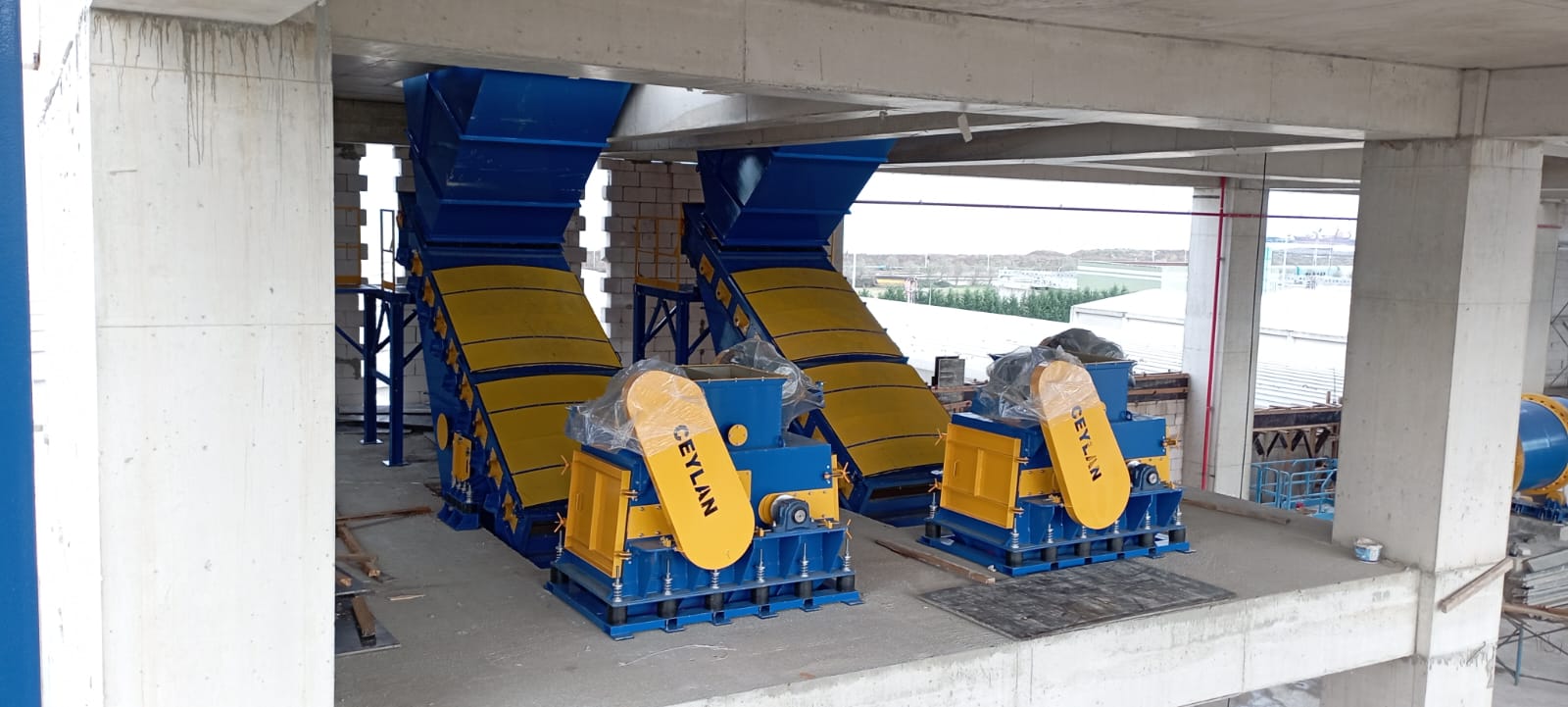
Ceylan Machine & Process manufactures double hammer mills for fertilizer granulation recycle loops, designed for continuous-duty oversize reduction with controlled output particle size, hardened alloy steel hammers, and quick-access maintenance design. For technical enquiries on crusher sizing for your NPK granulation line or to discuss oversize management in your recycle loop, contact our engineering team.