



Both hammer mills and chain mills appear in the crusher position of NPK and ammonium phosphate granulation recycle loops, and both are capable of doing the job. The choice between them isn’t arbitrary – each has a different reduction mechanism, different wear characteristics, different dust generation behaviour, and different suitability depending on the hardness and brittleness of the granules it’s being asked to crush. Specifying the wrong crusher for the formula doesn’t always show up as an obvious failure; it’s more likely to show up as higher wear part consumption than expected, or as a recycle stream that consistently skews toward either too many fines or too much remaining oversize – both of which push the granulation loop toward instability.
We’ll compare the two crusher types across the parameters that matter in recycle service: reduction mechanism, output particle characteristics, wear rates and replacement patterns, dust generation, and maintenance requirements.
What Each Machine Actually Does
Hammer mills use high-speed rotating rotors fitted with hammers – either free-swinging or rigidly fixed to the rotor – to reduce material by repeated impact. The rotor tip speed in a fertilizer hammer mill is typically in the range of 1,000 RPM or higher, and the impact energy per strike is substantial. Material fed into the milling chamber is struck by the hammers, broken by the impact and by contact with the casing liner, and passes through a screen aperture when it has been reduced below the screen opening. The screen is the primary control on output particle size.
In a dual-rotor configuration – where two counter-rotating rotors operate in series within a single casing – material passes through two impact stages in a single pass, producing a more thorough and controlled reduction than a single-rotor machine for the same screen setting. This is particularly relevant in recycle service where the inlet material (oversize granules of 4–8 mm or larger, depending on the upper screen cutpoint and the degree of agglomeration) needs to be reduced to the 2–4 mm range for effective seed recycling.
Chain mills use chains hanging from a rotating drum or rotor that impact and sweep material through the mill at lower tip speeds than a hammer mill. The reduction mechanism is less aggressive – more of a battering and sweeping action than the sharp impact of a rigid or swinging hammer – and the energy input per unit of material tends to be lower. Material is reduced by the cumulative effect of chain contact and by striking the mill casing, rather than by discrete high-energy hammer blows.
Reduction Mechanism and Output Particle Characteristics
The difference in reduction mechanism produces a meaningful difference in particle shape and size distribution at the outlet.
Hammer mills produce particles with sharper, more angular fracture surfaces. High-speed impact breaks fertilizer granules through the crystal lattice and along internal stress planes, producing fragments with irregular but well-defined edges. In recycle service, this fractured surface texture can be beneficial because it provides more surface area for binder attachment in the granulator bed – angular, fractured seed particles tend to nucleate new layered growth more readily than smooth, rounded particles.
Chain mills produce particles with a somewhat less angular shape. The lower energy sweeping action tends to abrade and chip granules rather than shatter them cleanly, and the particle shape at outlet is typically described as less angular than hammer mill product at comparable size fractions. For some NPK formulas this is an acceptable trade-off; for others, where the granulation mechanism relies on good nucleation from the recycle seed, the particle texture difference can affect the granule growth rate in the drum.
Both crusher types produce a spread of output sizes rather than a single target size, and both require screening of the crusher output – or a well-specified screen aperture on the mill itself – to control the size fraction returned to the granulator.
Suitability by Material Type
This is where the choice between the two crusher types tends to be most clearly driven, and the formula determines which way it goes.
Chain mills handle softer, more friable granule materials more comfortably. Urea-based NPK granules, urea-ammonium sulphate blends, and formulas where the nitrogen source dominates the mechanical properties of the granule tend to be relatively soft – they compress and crack more readily than they shatter. The lower energy input of the chain mill is adequate for these materials and avoids over-crushing to excessive fines, which would introduce too many sub-2 mm particles into the recycle stream and over-seed the granulator.
Hammer mills handle harder, denser granule materials more effectively. Granules with a high DAP, MAP, or MOP content – particularly those produced at lower moisture levels with a harder binder system – are stiffer and need more impact energy to crack reliably. Under-powered or low-energy reduction of hard granules can result in incomplete breakage and a higher proportion of particles passing through the crusher that still exceed the upper screen cutpoint. In this situation, the crusher is nominally in the loop but failing to do its job, and the oversized material simply recirculates until the cumulative granule growth makes it large enough to break.
Wear Rates and Replacement Patterns
Wear part consumption is one of the more significant operating cost differences between the two machine types in continuous recycle service, and the failure mode is different enough to affect how maintenance is planned.
In a hammer mill, wear is concentrated on the hammer tips – the striking face that impacts the material – and on the screen surface. Hammer wear is progressive: as the tip radius increases from wear, the impact energy per strike reduces, and particle size distribution at the outlet begins to coarsen. The transition from acceptable to unacceptable performance is gradual rather than sudden, which means a maintenance programme that tracks outlet size distribution and replaces hammers on a defined schedule – or when size distribution begins to drift – is more effective than waiting for visible failure. Individual hammers can be replaced independently, and rotors that allow hammer reversal can double effective hammer life by using both striking faces before replacement is needed. Screen wear is a separate consumable with its own replacement interval.
In a chain mill, wear is distributed across the chain links and the impact liner or anvil. Chains gradually stretch under the combined effect of impact loading and abrasive contact, which changes the effective sweep radius of the chain and the energy of each impact event. Chain wear is monitored by tracking chain length against a reference measurement. When chains have stretched beyond the design tolerance, they are typically replaced as complete assemblies rather than as individual links. The wear rate on the liner surface behind the chain path is a secondary wear item that needs monitoring during scheduled inspections.
For very abrasive fertilizer materials – granules with high phosphate rock content, for example – hammer wear rates in a hammer mill can be high enough to make hammer replacement a high operating cost. In these applications, hammer geometry and alloy selection matter considerably, and hardened alloy steel hammers are a minimum specification.
Dust Generation
In the recycle stream of an NPK granulation plant, dust generated by the crusher is not just a workplace safety and environmental concern – it directly affects the granulation loop. Crusher fines that are fine enough to become airborne within the enclosure but too small to be captured in the recycle stream will either be captured by the plant’s dust collection system (and either recycled or disposed of) or escape to the working environment. Fines that do return to the granulator as part of the recycle stream but are finer than the intended nucleation size (<1 mm) contribute to over-seeding, which pushes the granulator toward producing a product that’s too heavy on the fine end of the size distribution.
Hammer mills, operating at higher impact energy and rotor speeds, tend to generate more fine and dust-sized material per unit of feed than chain mills for comparable inlet particle sizes. The fraction of material reduced below the target seed size (2–4 mm in standard NPK service) tends to be higher from a hammer mill than from a chain mill, particularly if the screen aperture is set tightly or if the inlet material has a broad size distribution with a fraction of material that’s only marginally above the upper screen cutpoint and doesn’t need aggressive reduction.
Good enclosure design and aspiration at the crusher discharge point are important for both machine types, but the dust management requirement is generally more demanding for hammer mills in high-throughput continuous service.
Maintenance Requirements
Both machine types require a structured wear-part replacement programme to maintain consistent recycle performance. The maintenance access philosophy differs between the two.
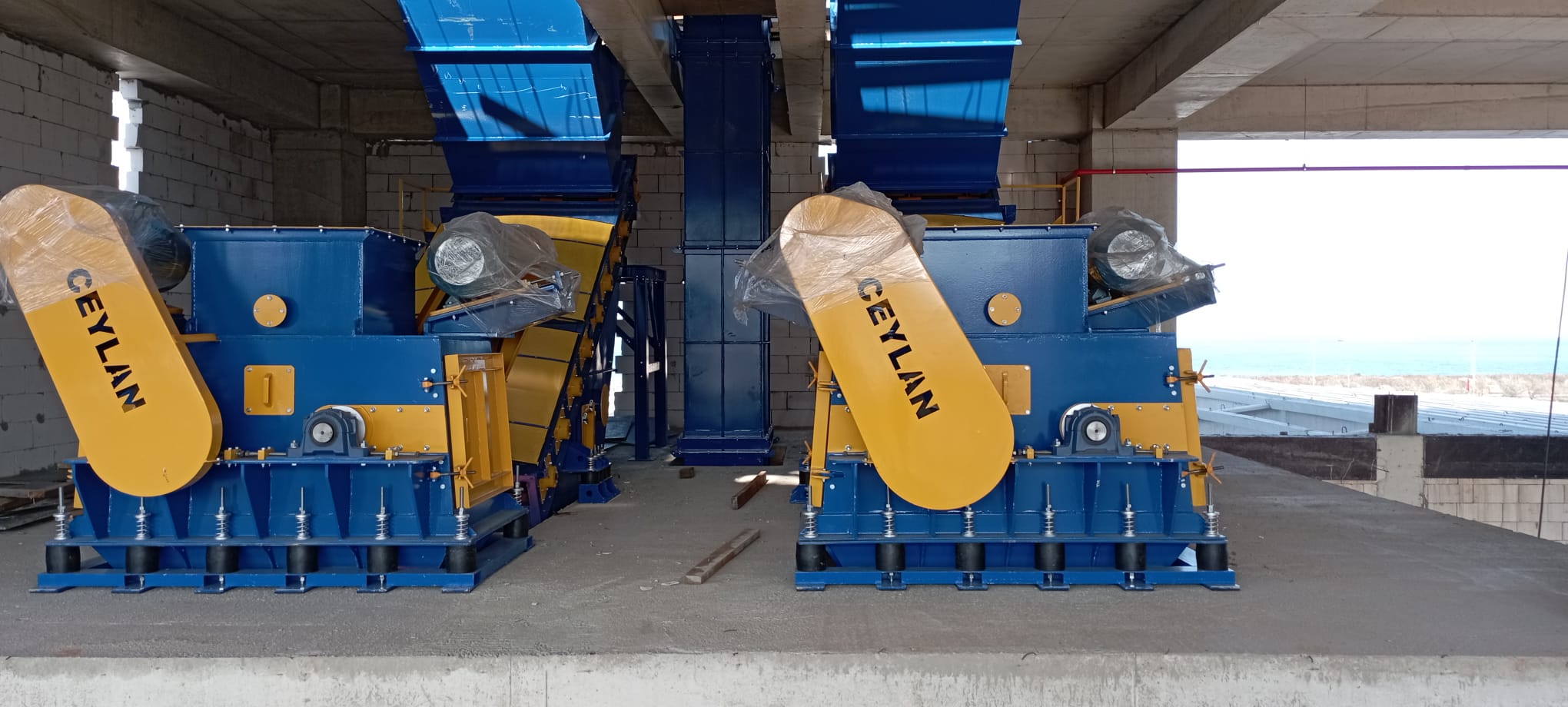
Hammer mills with quick-access doors and modular rotor designs allow hammer inspection and replacement without major dismantling. In a well-designed machine, maintenance crews can access the milling chamber, inspect hammer condition, and perform a hammer replacement in a planned stop of manageable duration. Screen inspection and replacement follow a similar pattern. The dual-rotor configuration of the Ceylan double hammer mill distributes the wear load across two rotor stages, which tends to extend the interval between hammer replacements compared to a single-rotor machine processing the same total throughput.
Chain mills have fewer individual components, but the chain assembly replacement, when it becomes necessary, is typically a more involved exercise than individual hammer swaps. The inspection cycle for chain stretch needs to be maintained, and the transition from acceptable to unacceptable chain condition can be faster once wear has progressed past a certain point – making a fixed inspection interval more important than in hammer mills where wear is more gradual.
Ceylan Machine & Process manufactures double hammer mills for fertilizer granulation recycle service and raw material size reduction, with hardened alloy steel hammers, PE1000 internal lining, and quick-access maintenance design. For technical enquiries on crusher selection for your granulation loop or to discuss your formula’s size reduction requirements, contact our engineering team.