



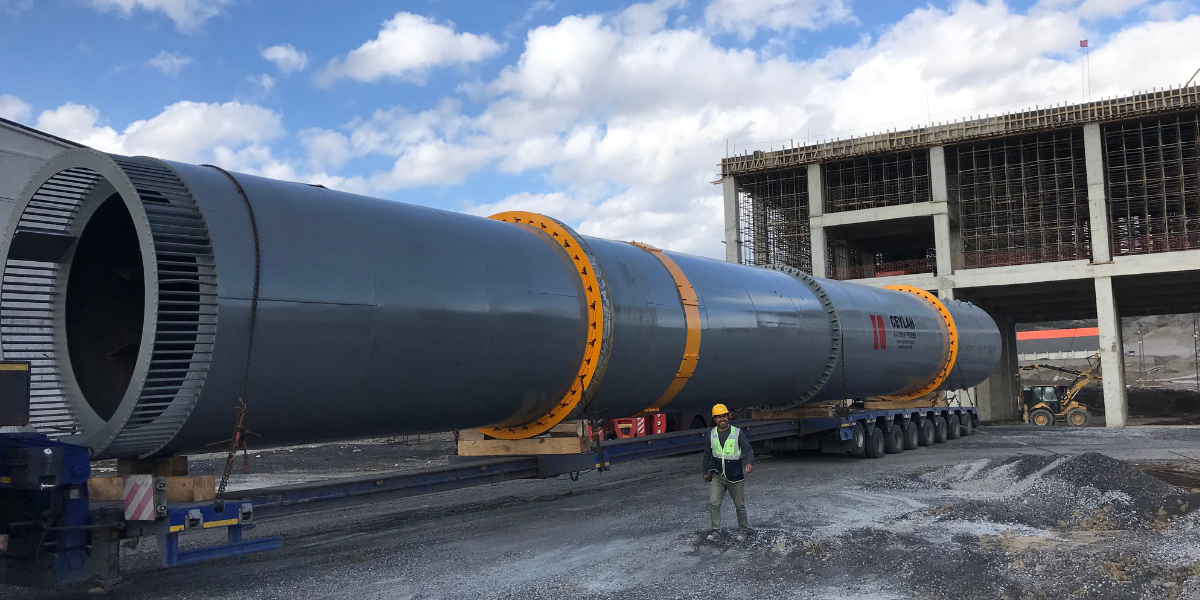
The flow configuration of a rotary drum dryer – whether the drying gas travels in the same direction as the material or against it – has a bigger effect on product quality, thermal efficiency, and operating flexibility than most plant specifications treat it as. The choice often gets made early in a project and then locked in at equipment procurement without the underlying reasoning being fully documented. When the wrong configuration is specified for a heat-sensitive fertilizer product, the consequences tend to show up only after the plant is running: product quality issues, elevated decomposition losses, or a cooler that’s constantly fighting product that’s too hot at the dryer outlet.
We’ll examine both configurations, the different temperature profiles they create inside the drum, their implications for thermal efficiency and product quality, and the considerations that should drive the selection decision.
What Each Configuration Actually Means
In a co-current rotary dryer (also referred to as a parallel-flow dryer), the hot drying gas and the wet material enter the drum at the same end. They travel in the same direction through the drum and both exit at the discharge end – the gas as humid exhaust and the product as dried material.
In a counter-current rotary dryer, the hot drying gas enters at the discharge end of the drum, travelling in the opposite direction to the material. The wet material enters at the feed end and meets gas that has already passed through the drum and partially lost its heat to the product.
The mechanical arrangement of both configurations is similar in its drum, slope, and flight system. What differs entirely is the gas entry and exit point relative to the material flow direction, and the temperature profile that results inside the drum.
Temperature Profiles: Where the Difference Actually Matters
Co-current configuration: the hottest gas meets the wettest material at the feed end of the drum. Because wet material has a high evaporative cooling capacity – the latent heat of vaporisation absorbs energy from the gas very efficiently when the moisture content is high – the product temperature at the feed end stays relatively low even though the gas entering may be at 200–400°C or higher depending on the application. As the material dries and loses its evaporative cooling capacity, the gas temperature has also dropped significantly by this point in the drum. The result is that the product exits the drum at a relatively moderate temperature, having been protected from the highest gas temperatures by its own surface moisture throughout most of its transit.
Counter-current configuration: the hottest gas meets the driest material at the discharge end. The material that’s closest to meeting the moisture specification – and therefore has the least evaporative cooling capacity remaining – is exposed to the incoming gas at its highest temperature. The product exits the drum at a significantly higher temperature than in co-current operation at comparable thermal conditions. At the feed end, the cooler, partially spent exhaust gas meets the wet incoming material, providing less aggressive initial drying but adequate evaporation capacity at high moisture levels.
Product Quality Implications for Fertilizer Drying
For most NPK fertilizer grades, co-current is the configuration that tends to be preferred, and the temperature profile is the primary reason. NPK formulas containing urea, ammonium nitrate, and other nitrogen-containing compounds that are sensitive to thermal degradation need to be kept below temperatures at which decomposition begins. Urea, for example, melts at around 133°C, with decomposition depending on temperature and exposure time. Ammonium nitrate and certain ammonium phosphate compounds have different but also defined thermal sensitivity thresholds that the design must account for.
In a counter-current dryer, the hottest gas at the discharge end is in contact with the driest, most thermally vulnerable product – exactly the combination most likely to cause localised overheating. In a co-current dryer, that same gas temperature is applied to the wettest material, where evaporative cooling helps limit product temperature even at high gas inlet temperatures. The drying is more aggressive at the point where the product can absorb it, and gentler at the point where the product is most vulnerable.
For mineral and chemical drying applications where thermal degradation is not a concern – sand, iron ore, phosphate rock, and similar materials – counter-current operation can be preferred because it can deliver higher thermal efficiency without the product temperature constraint that applies to nitrogen-containing fertilizer grades.
Thermal Efficiency Comparison
Counter-current dryers tend to achieve higher thermal efficiency than co-current dryers operating at the same material conditions, when thermal efficiency is measured as heat usefully transferred to the drying process per unit of fuel energy consumed. This is because the gas exits the drum at a lower temperature in counter-current operation – it’s used more completely before being exhausted – which means less energy leaves with the exhaust. The temperature differential between the gas and the material is also more consistently maintained along the drum length in counter-current operation, which improves the driving force for heat transfer.
Co-current dryers give up some thermal efficiency at the discharge end, where the gas temperature has dropped and the driving force for heat transfer is lower. This means the exhaust gas leaving a co-current dryer tends to be at a higher temperature than in counter-current operation, and carries more recoverable energy that can potentially be captured by a heat recovery system.
The practical efficiency difference between the two configurations depends on the specific moisture loads, the gas temperatures, and what heat recovery is in place on the exhaust stream. In well-insulated, well-instrumented systems with exhaust heat recovery, the efficiency gap between co-current and counter-current operation tends to narrow compared to what the theoretical temperature profiles suggest. For NPK fertilizer plants where the product temperature constraint makes co-current the appropriate choice anyway, optimising the co-current system’s exhaust heat recovery is typically more valuable than pursuing counter-current operation at the cost of product quality risk.
Making the Case to Management
For engineers who need to justify the flow configuration selection to a project manager or investment committee, the argument usually needs to translate the technical difference into commercial terms.
For heat-sensitive fertilizer grades: the case for co-current rests on product quality protection and regulatory compliance. Overheated NPK granule product can decompose, lose nitrogen content, discolour, and produce off-spec material that either needs to be reworked or written off. In severe cases, thermal incidents during drying of nitrogen-containing fertilizer materials carry safety implications that go beyond product quality. The additional energy cost of co-current operation – if any, once heat recovery is accounted for – is typically small relative to the cost of a product quality incident.
For thermally robust materials: the case for counter-current rests on potentially lower fuel consumption per tonne dried and lower exhaust gas volume that needs to be treated by the dust collection system. These are potential operating cost advantages that compound over the plant’s operating life. The absence of a product temperature constraint removes the main technical reason to accept the efficiency cost of co-current operation.
For plants that need to run multiple product types with different thermal sensitivities, the flow configuration is a design decision that’s very difficult to change after installation. If the product range includes both heat-sensitive nitrogen-containing grades and more thermally robust products, co-current is typically the safer default, with thermal efficiency recovered through good heat recovery design rather than through counter-current operation.
Ceylan Machine & Process designs and manufactures rotary drum dryers in both co-current and counter-current configurations for NPK fertilizer, mineral, and chemical drying applications. For technical enquiries on flow configuration selection for your specific product and process requirements, contact our engineering team.