



Screen blinding is one of the more insidious problems in fertilizer granulation, because it doesn’t announce itself with an obvious failure. The screen keeps running, the motor keeps turning, and the material keeps flowing. But somewhere between 80% and 90% of the effective mesh area has quietly been taken out of service by a layer of fine material adhered to the wires or by near-size particles wedged into the apertures. The screen is still classifying; it’s just classifying badly. And the signal that something is wrong arrives downstream, disguised as a rising recycle ratio, inconsistent product size, or customer complaints about granule uniformity that takes days to trace back to the screen.
We’ll cover the mechanisms that cause blinding in fertilizer screening, why certain product types are particularly vulnerable, what blinding does to the rest of the granulation loop, and the engineering responses that address it at the root rather than the symptom.
What Blinding Actually Is
Blinding is the progressive reduction of the effective open area of a screen mesh by the adhesion or wedging of material at or near the apertures. It comes in two distinct forms that have different causes and respond to different remedies.
Adhesive blinding occurs when fine particles or granule fragments adhere to the wire surfaces or panel faces of the mesh, coating the wires and narrowing or fully blocking the apertures. The driving mechanism is surface moisture: material that carries residual moisture from the drying stage, or that has absorbed atmospheric moisture due to its hygroscopic nature, becomes sticky enough at its surface to bond to the mesh wire when it comes into contact. Once the first layer of material adheres, subsequent particles adhere to that layer, and the blinding progressively thickens until the aperture is fully closed.
Near-size blinding (also called pegging or plugging) occurs when particles that are close to the mesh aperture size enter the opening but are not small enough to pass through. They become mechanically wedged in the aperture, where the screening motion may hold them in place rather than ejecting them. The aperture is physically blocked even though neither the wire nor the particle surface is particularly sticky. Near-size blinding is most severe when the product size distribution has a significant fraction of particles within ±10–15% of the mesh aperture size, and it is aggravated by high feed rates that push more particles through the apertures simultaneously.
Both forms can occur on the same screen at the same time, and they tend to reinforce each other: adhesive blinding reduces the effective aperture size of unblocked openings, which increases the fraction of near-size particles relative to the remaining open area.
Why Fertilizer Products Are Particularly Prone to Blinding
The physical chemistry of fertilizer materials makes blinding a more significant problem in fertilizer screening than in many other granular material applications. Several product types are particularly vulnerable.
Urea is one of the more hygroscopic materials routinely handled in fertilizer production. At relative humidity levels commonly encountered in production environments, urea granules begin to absorb atmospheric moisture onto their surface within minutes of exposure. This moisture uptake is sufficient to make the granule surface tacky enough to adhere to screen wires, and the effect is most pronounced in the warmer and more humid portions of the year in most production locations.
Ammonium nitrate and ammonium-nitrate-containing NPK blends are similarly hygroscopic. Ammonium nitrate’s critical relative humidity, the humidity level above which it begins to absorb moisture from the air, is relatively low compared to many other fertilizer salts, which means it can begin to take on surface moisture even in moderately humid conditions. Formulas with a high ammonium nitrate fraction require attention to both the screen design and the ambient humidity conditions in the screening area.
NPK grades with high nitrogen content from these sources combine the hygroscopicity of the nitrogen component with the varied particle characteristics of a compound granule. The granule surface may be rougher and more textured than a single-salt product, providing more surface area for moisture retention and adhesion to screen wires.
Even formulas based on less hygroscopic materials (DAP, MAP, muriate of potash) can cause blinding if the granule arrives at the screen with surface moisture above the design target, either because the dryer is undersized or operating above its moisture capacity, or because the recycle ratio has been running high and wet recycle seed is moving through the system.
What Blinding Does to the Granulation Loop
A screen operating with reduced effective open area does not fail cleanly; it produces a degraded classification that misidentifies material in both directions. On-spec granules arrive at apertures that are partially blocked, cannot pass through to the product fraction, and report instead to the oversize fraction to be recycled or to the feed for regrinding. Off-spec material, granules that are genuinely outside the target size range, arrives at apertures that are just wide enough to allow them through because the blinding has altered the effective aperture size, and passes into the product stream as if it were on-spec.
The practical consequences in a granulation loop are the same ones described in the recycle ratio discussion: an artificially elevated recycle ratio (because more on-spec material is being rejected than the granulator actually produced), and product quality below the nominal specification because misclassified granules are passing into the product fraction. The plant may be running at full throughput and making material, but it’s making less good product and more recycle than it should.
What makes blinding particularly difficult to diagnose is that the screen appears to be operating correctly from a mechanical standpoint. The drives are running, the amplitude looks normal, and the material is flowing across the deck and discharging at the right fractions by volume. The blinding isn’t visible to an operator doing a routine walkthrough. Only a detailed inspection of the mesh surface, which requires stopping the screen and getting close to the deck, reveals the progressive coating of the wire surfaces or the wedged particles in the apertures.
Engineering Solutions
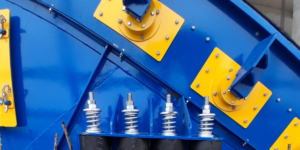
Direct excitation of the screen mesh. The most effective anti-blinding approach at the mesh level is delivering the vibration energy directly to the screen cloth itself rather than to the screen housing as a whole. In a conventional whole-body vibrating screen, the entire frame oscillates and the mesh moves with it, but the amplitude and acceleration at the cloth surface are attenuated by the cloth’s own mechanical response to the structural vibration. In a direct excitation design, electromagnetic drives apply oscillation directly to the mesh, achieving accelerations at the cloth surface significantly higher than what whole-body vibration can deliver to the mesh through the frame. Accelerations in the range of up to 15g at the cloth surface are achievable with direct excitation systems, and the high acceleration prevents fine particles from dwelling long enough on the wire surface to form an adhesive bond.
This approach also has the advantage of a static housing: because the vibration energy is applied to the cloth rather than the frame, the frame itself does not vibrate significantly. This reduces the structural load transmitted to the installation and eliminates the fatigue loads on the frame welds and mounts that accumulate over years of operation in whole-body vibrating screens.
Zone vibration and frequency variation. Applying different vibration frequencies or amplitudes across different zones of the same deck allows the screen to tailor its anti-blinding action to the different material conditions across the deck length. At the feed end, where the material layer is deepest and the moisture content is highest, more aggressive vibration helps prevent initial adhesion. Toward the discharge end, where the material layer is thinner and the remaining fraction is predominantly near-size, different frequency characteristics can be used to reduce pegging. This zone-specific approach to vibration is achievable through individual electromagnetic drives positioned at multiple points along the deck, each adjustable independently.
Anti-blinding knockers and ball systems. A complementary approach used in some screen designs involves mechanical knockers or rubber ball systems positioned beneath the mesh. Knockers impact the underside of the mesh at intervals, dislodging adhered material from the wires before blinding can progress. Rubber ball systems use balls contained in compartments beneath the mesh that bounce against the underside as the screen vibrates, providing a distributed percussion effect across the mesh area. These systems are most effective against adhesive blinding and are less effective against pegging, where the mechanical wedging force exceeds what a ball or knocker can reliably overcome.
Mesh material selection. Polyurethane screen panels, used in place of conventional woven wire mesh, have different surface properties that reduce adhesive blinding in hygroscopic fertilizer applications. The polyurethane surface is smoother than woven wire and has different surface energy characteristics that reduce particle adhesion. Polyurethane panels also tend to have better wear resistance than wire mesh in abrasive material service, and their self-dampening mechanical properties reduce the accumulation of near-size particles in the apertures under some operating conditions. The trade-off is that polyurethane panels typically have lower open area than woven wire mesh at the same nominal aperture size, which reduces throughput per unit of deck area. The right choice depends on the specific product’s hygroscopicity and the severity of blinding experienced in service.
Humidity control in the screening environment. The root cause of adhesive blinding in hygroscopic fertilizer products is surface moisture uptake from the plant environment. Where blinding is persistent and driven primarily by ambient humidity rather than by residual moisture from the dryer, controlling the humidity in the immediate vicinity of the screen can reduce the rate at which granule surfaces become tacky. This can be approached through local enclosure of the screening area with conditioned air supply, or through heating the incoming material or the screen housing to keep the granule surface temperature above the local dew point. These approaches add operational complexity and cost, but they address the driving mechanism of hygroscopic blinding at its source rather than managing its consequences at the mesh surface.
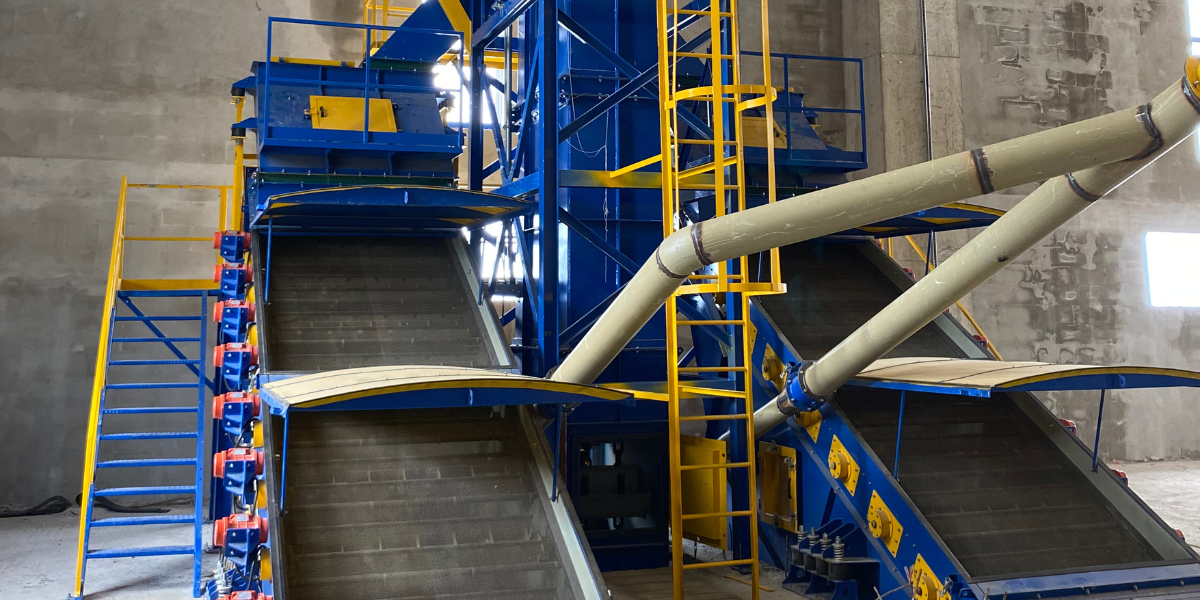
Ceylan Machine & Process manufactures inclined vibrating screens with direct-excitation electromagnetic drives and zone-specific vibration systems for NPK, DAP, MAP, and urea fertilizer granulation loops. For technical enquiries on screen blinding prevention or to discuss the screening requirements for your specific product, contact our engineering team.