





Fertilizer Bulk Blending Plants
Fertilizer blending plants tailored to your formulations, production targets, and site. From precise dosing and mixing to packaging, we deliver complete systems with design, commissioning, and ongoing support.
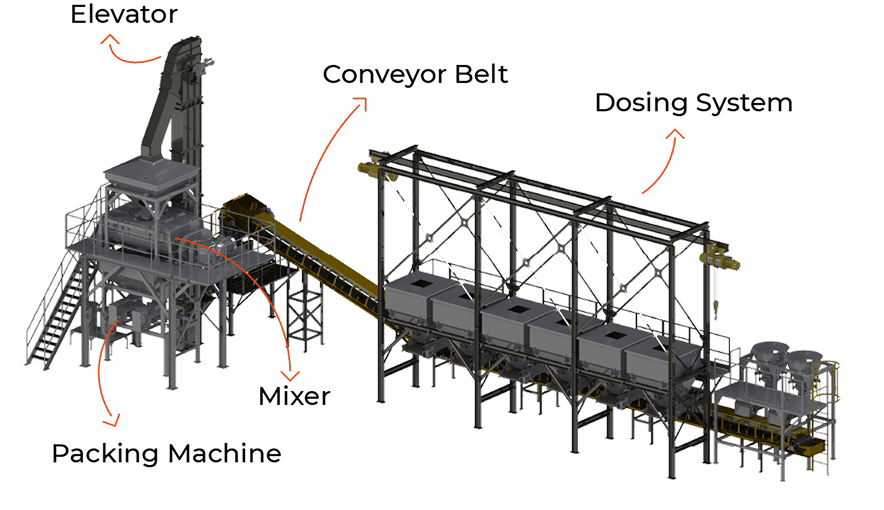
STEP 1 : Raw Material Preparation
- Raw Material Receiving (Big-Bag / Loader)
- Belt Feeding with Fertilizer Dosing System using “4 load cells” for accurate weighing
- Belt conveyors fitted with VFD speed control for precise material flow
- Dust Collection at Transfer Points to protect safety and maintain a clean, low-dust environment in fertilizer plants
STEP 2 : Blending Process
- Precision Batch Blending: Our fertilizer blending system uses a heavy-duty batch mixer, such as a double-shaft paddle mixer, operating with a controlled mixing time of approximately 6 minutes to achieve complete and homogeneous blending. This prevents product segregation and dead zones, ensuring blend reliability.
- Continuous Batch Flow: The mixer is supported by a pre-batch hopper with weighing units, allowing preparation of the next batch while the current batch is mixing. This reduces downtime, improves efficiency, and stabilizes throughput in industrial blending operations.
- Quality Control and Reporting: Real-time monitoring and reporting systems maintain blend integrity, track mixing time, and detect any deviations in dosing rates or mixer operation to ensure consistent product quality.
STEP 3 : Packaging and Storage
Accurate Bagging: The blended fertilizer is discharged into the bagging hopper, then fed to the packing machinery via a controlled belt feeder for a smooth, stable flow. The bagging scale uses load cells combined with coarse/fine feeding logic (fast fill followed by slow top-up) to achieve the correct target weight consistently and reduce material loss.
Bag Closing & Handling: Filled bags proceed through automatic bag sewing or heat sealing, depending on bag type. Optional checkweighers can be integrated for quality assurance and efficient packaging at industrial throughput rates.
STEP 4 : Dedusting
Effective dedusting systems are essential to protect equipment, improve safety, and maintain product quality by minimizing airborne powders during transfer and packaging.
Extraction points at raw-material feeding, conveyor transfers, mixer discharge, and bagging capture airborne fertilizer dust where it is generated.
Extracted air passes through a filtration system that separates dust from the airflow. Collected dust is discharged into designated containers for controlled handling.
Extraction points, filters, and equipment materials are selected according to the fertilizer characteristics, dust load, and plant layout. Access for inspection, cleaning, and filter maintenance supports reliable operation.

See Our Bulk Blending Plant in Action
Take a closer look inside our fertilizer bulk blending plant in Körfez, Kocaeli, Türkiye. This short video shows the facility layout and equipment on site.
Customize Your Bulk Blending Plant
Our bulk blending plants are configured to match your production requirements and available site layout. Use the specifications below as a starting point, then share your project details with our team.
Technical Specifications
| Parameter | Specification |
|---|---|
| Production capacity | 5–20 tonnes/hour |
| Raw-material receiving | Big-bag unloading or loader feeding |
| Raw-material bins | Number and size tailored to customer requirements |
| Dosing system | Dosing based on load-cell weight readings |
| Packaging | Open-mouth or FFS bagging, according to customer requirements |
| Dust collection | Integrated dust collection system |
| Space requirements | Calculated individually to suit the customer’s site layout |
Start with your requirements
What you provide
Share your target capacity, raw materials, desired bag sizes, and available site space.
What we help define
We help define the dosing and mixing configuration, material handling, packaging, and plant layout around your requirements.
Your next step
Contact our team to discuss your requirements and request a project-specific quotation.
Frequently Asked Questions
What is a fertilizer bulk blending system?
A fertilizer bulk blending system mechanically mixes a variety of granular and powdered raw materials into a uniform blend according to a defined formulation. These batch blending systems allow flexible fertilizer production by dosing multiple grades of raw materials precisely using weigh hoppers and dosing systems.
Can the system be customized for specific facilities?
Yes. Fertilizer blending plants are designed around your site layout, available space, and desired output rates. Customization options include storage configuration, integration with downstream packaging, and the choice of batch mixers or continuous blending machines to suit your operational needs.
How is blend accuracy controlled?
Blend accuracy is maintained through calibrated dosing systems, precise weighing with load cells, and optimized mixing time in batch mixers to ensure complete homogeneity. This minimizes product segregation and dead zones, resulting in reliable nutrient distribution within each batch.
Is bulk blending suitable for high-capacity fertilizer production?
Yes. A properly engineered fertilizer blending plant with reliable batch blending machines, dosing systems, and weigh hoppers can support high throughputs. The system design accounts for mixing time, material flow, and packaging integration to achieve efficient, continuous operation.