



The choice between an inclined and a horizontal vibrating screen is one that gets made early in a plant design and is very difficult to change afterwards. The screen sits in the middle of the granulation loop; its physical footprint determines what’s installed around it, and its performance characteristics set the ceiling on product quality and recycle management across the life of the plant. Getting that choice right requires understanding what actually differs between the two configurations beyond the obvious angle of inclination, because the differences in throughput behaviour, separation accuracy, structural loading, and maintenance access are all consequences of that one physical distinction.
We’ll compare both configurations across the parameters that matter for fertilizer granulation duty: material transport mechanism, throughput capacity, separation accuracy, structural loading, and maintenance considerations, and give guidance on when each is the stronger choice.
How Each Configuration Moves Material
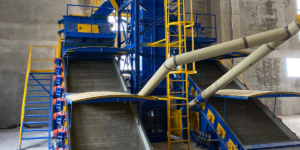
In an inclined vibrating screen, typically inclined at an angle of 15–20° from horizontal, gravity acts as a continuous force driving material toward the discharge end. The vibratory motion, whether circular, elliptical, or linear depending on the drive arrangement, provides the agitation that stratifies particles by size and allows near-size particles to find and pass through mesh apertures. Material travels across the deck relatively quickly because gravity and the vibration component act in the same direction toward the discharge. The result is a high material transit rate and therefore high throughput per unit of deck area.
In a horizontal vibrating screen, the inclination is flat or close to it, and gravity does not contribute to material transport toward the discharge. The drive system uses a linear vibration motion, typically generated by counter-rotating eccentric masses, that propels material forward along the deck in a series of small throw-and-land cycles. Material advances more slowly across the deck than in an inclined configuration, and the vibration angle and amplitude are the primary controls on both material travel speed and the stratification and penetration behaviour at the mesh.
This difference in material transit speed is the root of most of the other differences between the two configurations.
Throughput Capacity
For a given deck area, inclined screens typically achieve higher throughput than horizontal screens, because the gravity-assisted transport allows more material to flow through the machine per unit time. The higher transit rate means the material layer depth on the deck is lower at a given feed rate, which improves the probability of fine particles reaching the mesh surface and penetrating the apertures.
For large-scale fertilizer granulation plants where screening a high total circulating load, product plus recycle, is the primary throughput constraint, the inclined configuration tends to deliver more classification capacity per unit of screen footprint. This is particularly relevant in NPK granulation plants where the total circulating load through the screen, at a recycle ratio of 3:1 to 4:1, is several times the product output rate.
Separation Accuracy
Horizontal screens tend to achieve higher separation accuracy for difficult near-size cuts than inclined screens at comparable deck area, because the slower material transit gives particles more time to stratify by size and more opportunity for near-size particles to find and pass through the apertures. In a horizontal screen, material dwells on the deck for longer and the screening is more thorough per unit of material.
For standard NPK, DAP, and MAP granule classification in a granulation loop, where the target is typically a two-deck separation into oversize, on-spec, and undersize fractions with relatively wide size windows (for example, upper cut at 4–5 mm and lower cut at 1.8–2.5 mm, depending on the product specification), the separation accuracy of a well-specified inclined screen is generally adequate. The size difference between the fractions being separated is large enough that the faster transit rate of the inclined configuration doesn’t significantly compromise the classification quality.
Where horizontal screens show a meaningful accuracy advantage over inclined configurations is in applications with tight size cuts, separating a product with a narrow target band (for example, a specialty fertilizer requiring 90% of granules within a 0.5 mm window) or when the feed contains a very high proportion of near-size particles. In standard NPK granulation loops, these conditions are less common than in some mineral and chemical classification applications.
Structural Loading and Installation
One of the more practically significant differences between the configurations, particularly for plants evaluating a new screen or retrofitting an existing plant structure, is the dynamic load transmitted to the installation.
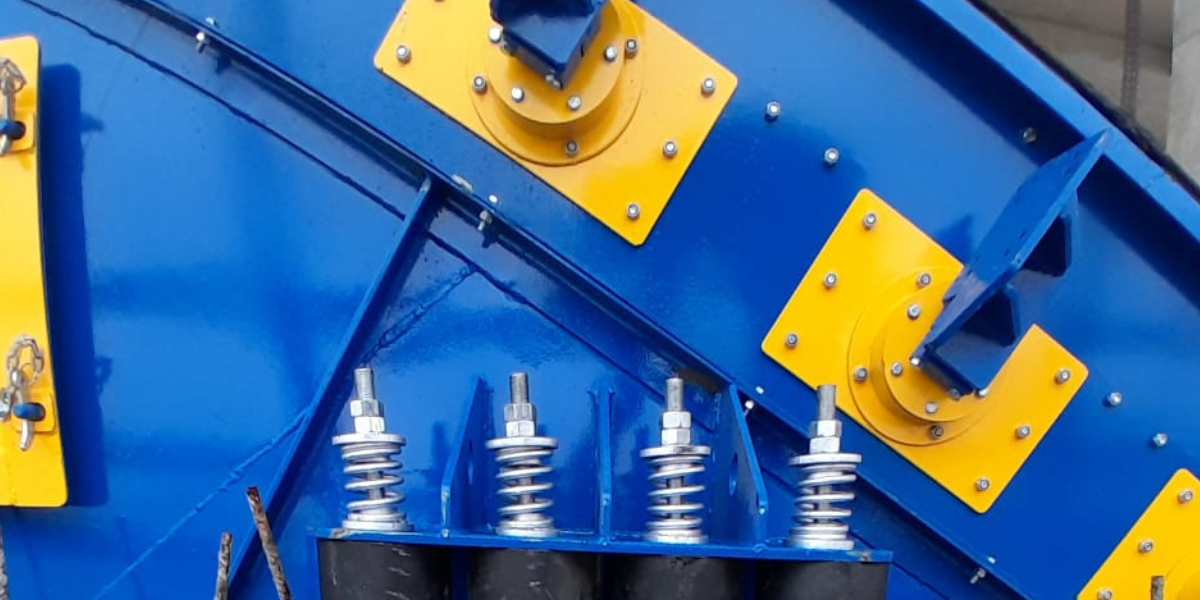
A conventional whole-body vibrating screen, whether inclined or horizontal, transmits substantial dynamic loads to the support structure through its isolation springs and mounts. Over time, this cyclic loading requires attention to the fatigue condition of the support steel, the condition of the isolation elements, and the mounting connections. In multi-deck configurations with high material loading, the transmitted dynamic loads can be significant enough to constrain the installation height or require reinforcement of the support structure.
An inclined screen with direct excitation of the screen mesh, rather than whole-body vibration of the frame, operates with a largely static housing. The vibration energy is concentrated in the mesh rather than in the frame, which means the dynamic load transmitted to the support structure through the isolation mounts is substantially lower than in a conventional whole-body vibrating screen of comparable size. This has two practical consequences: the support structure can be lighter and less expensive for the same screen size, and the fatigue condition of the frame welds and mounting hardware is less severe over the operating life of the equipment.
For retrofit installations where the available support structure has limited capacity for dynamic loads, the static housing design of a direct-excitation inclined screen may allow installation in a location that couldn’t accommodate a conventional vibrating screen without structural reinforcement.
Maintenance Considerations
Screen maintenance in fertilizer plants is primarily driven by three activities: deck inspection for blinding or damage, mesh replacement, and drive component servicing.
For mesh inspection and replacement, both configurations provide access to the deck surface from the sides of the screen housing, but the inclined configuration’s slope can affect the ease of access from the operator’s standpoint. A well-designed inclined screen with side access doors at appropriate intervals along the deck allows inspection and mesh replacement without removing major structural components, and quick-release mesh fixing systems can allow a full screen cloth change in a controlled, planned stop of short duration.
For drive servicing, the direct excitation approach used in some inclined screens has a different maintenance profile than conventional eccentric-shaft drives. Electromagnetic direct excitation drives have no rotating mechanical components in contact with each other, which eliminates the bearing wear and lubricant management associated with conventional vibrator drives. The maintenance requirement for the excitation system is primarily electrical, confirming coil condition and air gap, rather than mechanical.
Horizontal screens with conventional eccentric-shaft drives have rotating shaft bearings that require regular lubrication and inspection, and bearing replacement at the end of service life. The maintenance cycle for these components is well established and can be planned around production schedules.
Both configurations require periodic inspection of the isolation springs or mounts. For whole-body vibrating screens, isolation spring condition is particularly important because degraded springs allow higher dynamic loads to reach the structure. For static-housing direct-excitation designs, the isolation requirement is different and typically less demanding.
When to Choose Inclined
The inclined configuration tends to be the stronger choice for:
- High-throughput fertilizer granulation plants where screening a large total circulating load is the priority constraint. The gravity-assisted transport delivers more classification capacity per unit of deck area than a horizontal screen at the same throughput.
- Standard NPK, DAP, MAP, and urea granule classification where the size windows are wide enough that the slightly lower accuracy of the inclined configuration relative to horizontal is not a practical limitation.
- New plant designs where minimising the structural load on the screen support is desirable, particularly when using a direct-excitation static-housing design.
Plants with significant screen blinding risk, hygroscopic products, or variable inlet moisture, where the combination of gravity-assisted transport and high-acceleration direct excitation provides robust anti-blinding performance.
When to Choose Horizontal
The horizontal configuration tends to be the stronger choice for:
- Applications with narrow or demanding size cuts where maximum separation accuracy is the priority and throughput is secondary.
- Specialty fertilizer grades requiring tight PSD control that cannot be reliably achieved with the faster transit rate of an inclined screen.
- Materials with a broad particle size distribution and a high near-size fraction, where the longer dwell time of the horizontal configuration improves the probability of near-size particles finding and passing through the apertures.
- Applications where upstream equipment layout requires a flat-plane material handoff and the installation of an inclined screen would require an additional elevation change in the material handling path.
Ceylan Machine & Process manufactures inclined vibrating screens with direct excitation electromagnetic drives and static housing for NPK, DAP, MAP, and urea fertilizer granulation loops, with ATEX CE certification and two-stage deck classification. For technical enquiries on screen configuration selection or to discuss your plant layout requirements, contact our engineering team.