




Telescopic Conveyor Belt - Truck Loading
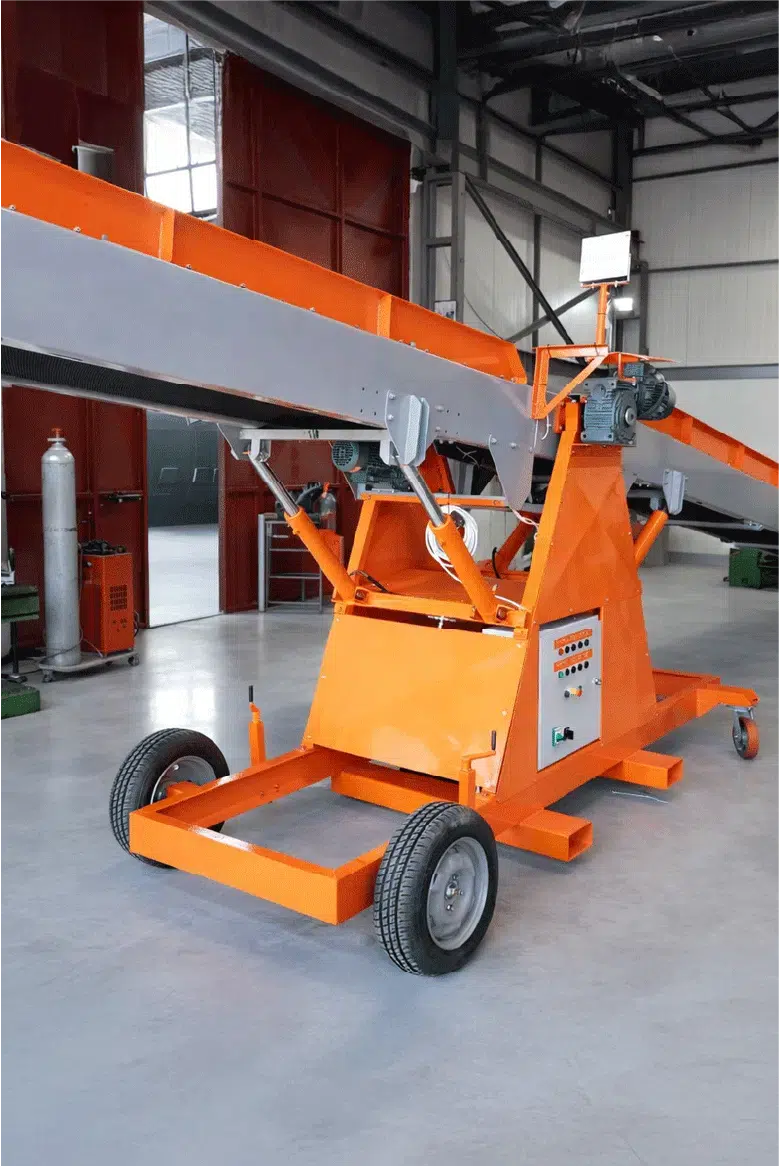
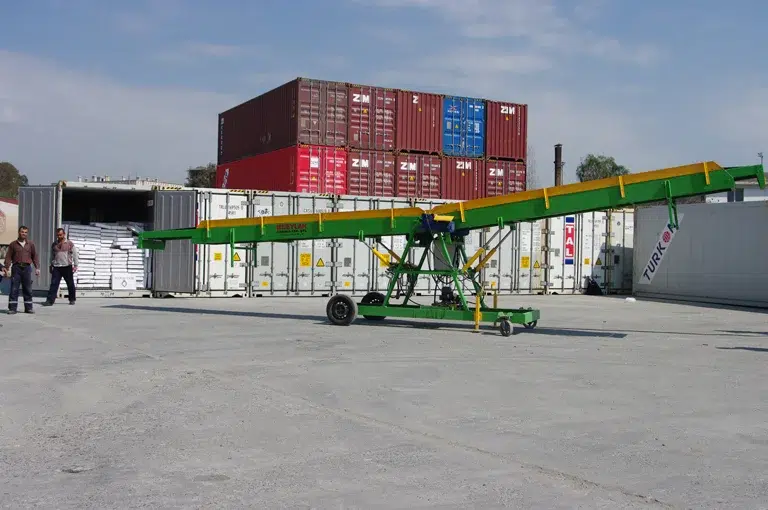
A double‑boom, mid‑base telescopic conveyor belt is a two-sided, mobile conveyor belt with a central chassis/base and two telescopic booms extending in opposite directions. Each boom can extend/retract (telescopic reach) via chain drive and raise/lower (lift & fall) via hydraulics. The telescoping motion is chain‑driven on both sides to keep the boom sections square and stable. The whole unit is supported on mobile casters so it can be repositioned.
The distance between the two endpoints of the telescopic conveyor belt is 23 meters.
The maximum height it can deliver product to is 4.5 meters from the ground.
Belt speed 1.1 meters/second, which is 50 boxes or sacks (50kg) per minute.
3 main drives;
1 for driving belt,
2 for driving booms in/out
Description
Best Use Cases
- Two-sided loading/unloading (e.g., truck to container, two work zones)
- Flexible trailer/container reach where door positions and dock heights vary
- Sites with limited dock equipment where a mobile solution is preferred
- Loading of trucks after packing operations
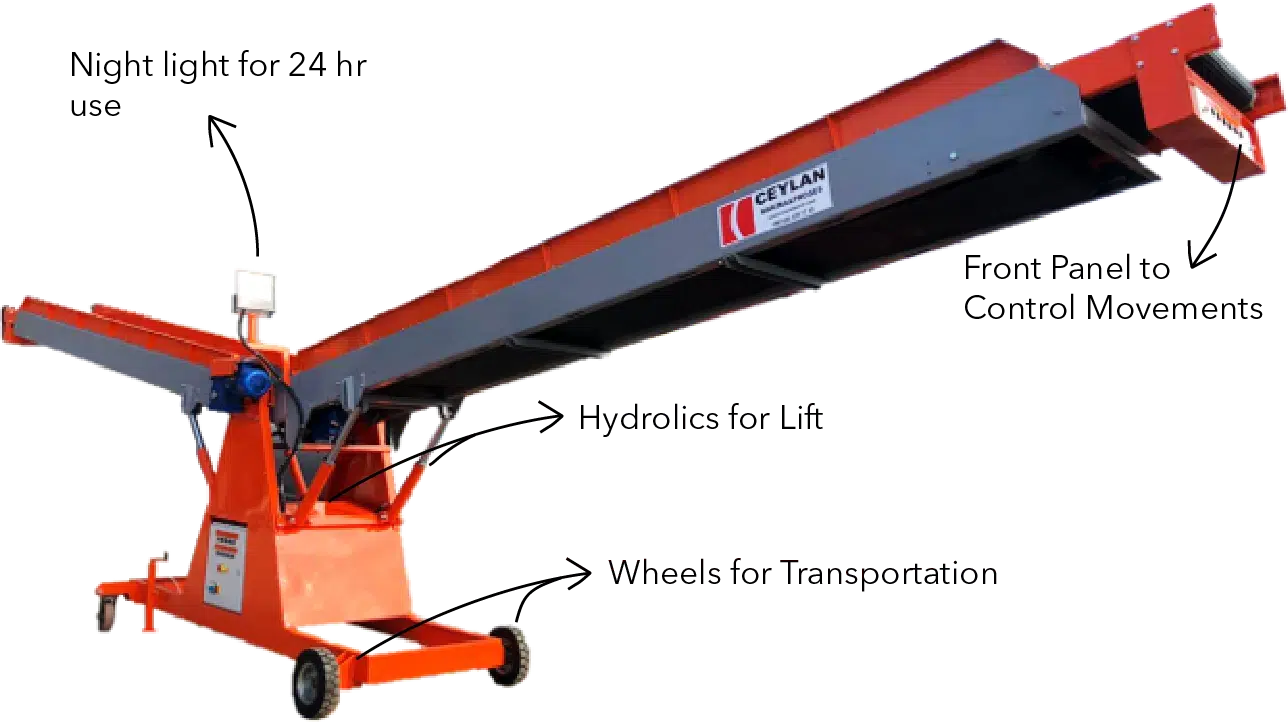
Main Features of the Telescopic Conveyor Belt
- Caster wheels with locking brakes for mobility
- 5 mm sturdy conveyor frame for stiffness and long service life
- Variable speed (VFD) for gentle start/stop
- 4 kW main drive unit for reliable operation
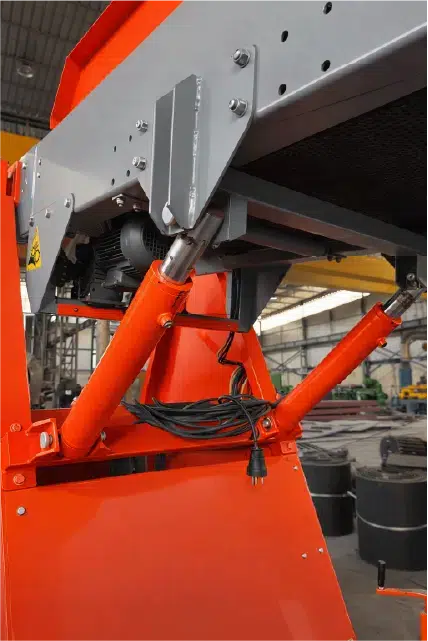
- Hydraulic cylinders for lift/lower (luffing) to position the belt inside the container
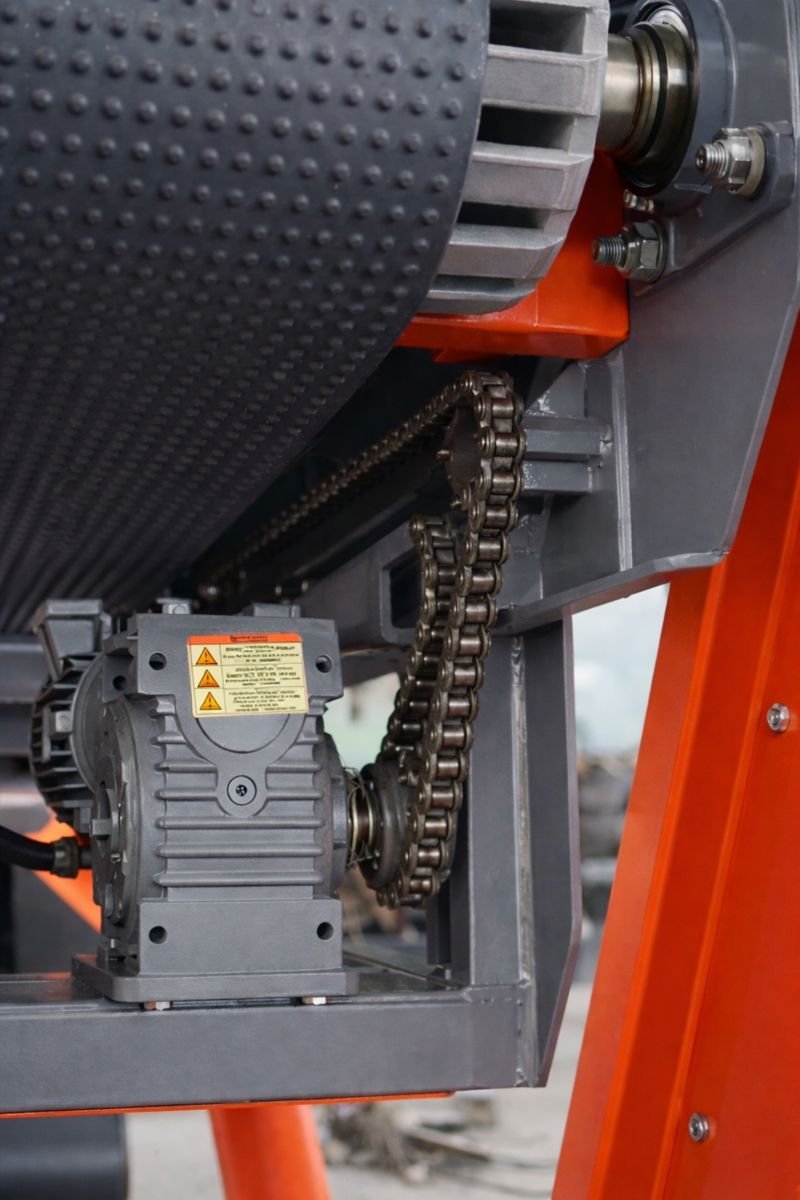
- Chain-driven boom travel with reliable drive control and smooth movement
Why Do Our Telescopic Conveyors Perform Longer?
- Stronger Conveyor Frame : Our telescopic belt’s conveyor frame is made of a 5 mm-thick structural steel, which provides sufficient resilience for sudden drops of bags.
- Chains to extend/retract Telescopic Booms : The two-sided conveyor belt has a chain-driven retract system that gives mechanical pull, so the boom retracts smoothly even under varying load, dust, or bag contact, without relying on seal friction or oil pressure.
- Two-sided Telescopic Boom Design : Our two-sided design of the telescopic conveyor belt provides sufficient leverage to work both inside the container and inside the truck. Allows the operator to use the belt as the work distance increases.
- Hydraulic Stability Under Load : Controlled lifting and a centralized hydraulic system provide smooth lift and drop.
Specifications
Main drive power
Length extended/retracted
Drive type of booms
Boom controls
On boom ends/remote
Reach height
Belt speed
Why Choose Our Telescopic Belts?
The defining feature of our telescopic conveyors is that boom extension and retraction are chain-driven rather than hydraulic. A dual-strand roller chain positively couples the drive sprocket to the moving boom section, so travel is governed by a fixed kinematic ratio instead of fluid displacement. In practical terms, every rotation of the drive shaft advances the boom by a known, repeatable distance — the motion is deterministic, not pressure-dependent.
The chain drive is also self-holding under static load, so the boom stays put at any point in its stroke without maintaining hydraulic pressure. Combined with the 5 mm structural-steel frame and centralized hydraulic luffing for lift, the result is a conveyor that positions accurately, holds position reliably, and shrugs off the dust, bag contact, and duty cycle of continuous truck loading — the conditions where sealed hydraulic extension systems tend to degrade first.
Frequently Asked Questions
How far can the telescopic conveyor reach?
Each boom extends and retracts independently, giving an overall span of 23 m fully extended and 12 m retracted, with product delivered up to 4.5 m above ground. Because the unit is double-boom, it can feed two work zones at once — for example a truck on one side and a container on the other — without repositioning the base.
How is the belt speed and loading rate controlled?
The 4 kW main drive runs through a variable-frequency drive (VFD), giving gentle start/stop and adjustable belt speed around the nominal 1.1 m/s. At that speed the conveyor handles roughly 50 bags (50 kg) per minute, and the rate can be tuned to match upstream packing output.
Why is the boom travel chain-driven rather than hydraulic?
Chain drive couples the motor to the boom through direct tooth-to-link engagement, so extension follows a fixed mechanical ratio instead of fluid pressure. Travel stays consistent whether the boom runs empty or loaded, and the drive holds its position without maintaining hydraulic pressure. Hydraulics are reserved for lift and lower (luffing), where controlled pressure is an advantage.