




Convoyeur télescopique - Chargement de camions
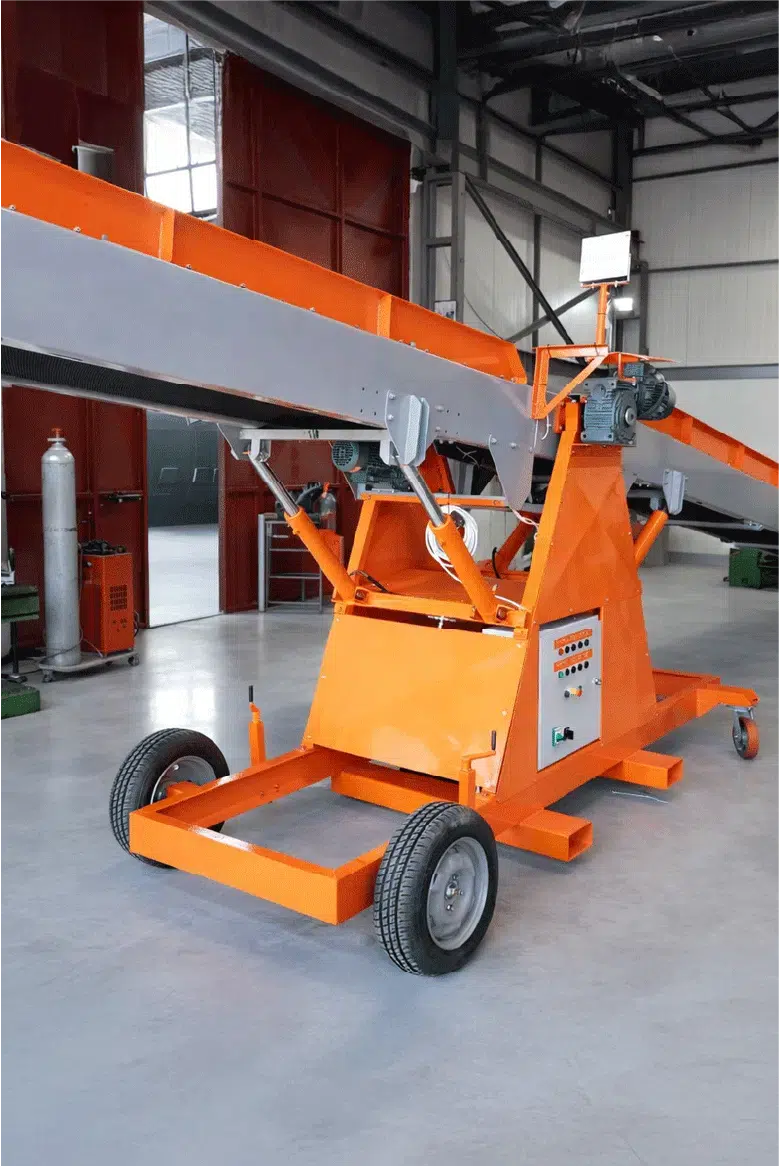
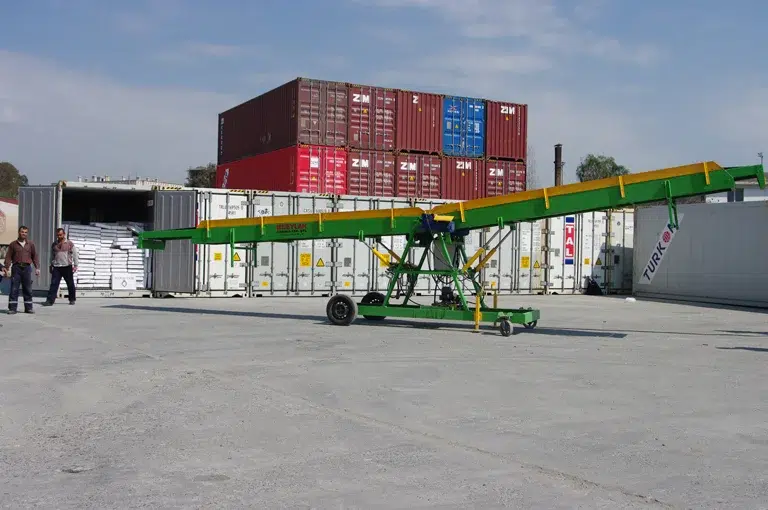
A double‑boom, mid‑base telescopic conveyor belt is a two-sided, mobile conveyor belt with a central chassis/base and two telescopic booms extending in opposite directions. Each boom can extend/retract (telescopic reach) via chain drive and raise/lower (lift & fall) via hydraulics. The telescoping motion is chain‑driven on both sides to keep the boom sections square and stable. The whole unit is supported on mobile casters so it can be repositioned.
La distance entre les deux extrémités du tapis roulant télescopique est de 23 mètres.
La hauteur maximale à laquelle il peut livrer le produit est de 4,5 mètres au-dessus du sol.
Belt speed 1.1 meters/second, which is 50 boxes or sacks (50kg) per minute.
3 entraînements principaux ;
1 pour la courroie d'entraînement,
2 pour l'entrée/sortie des flèches
Description
Best Use Cases
- Chargement/déchargement bilatéral (par exemple, camion vers conteneur, deux zones de travail)
- Portée flexible des remorques/conteneurs selon la position des portes et la hauteur des quais
- Sites disposant de peu d'équipements de quai où une solution mobile est privilégiée
- Loading of trucks after emballage operations
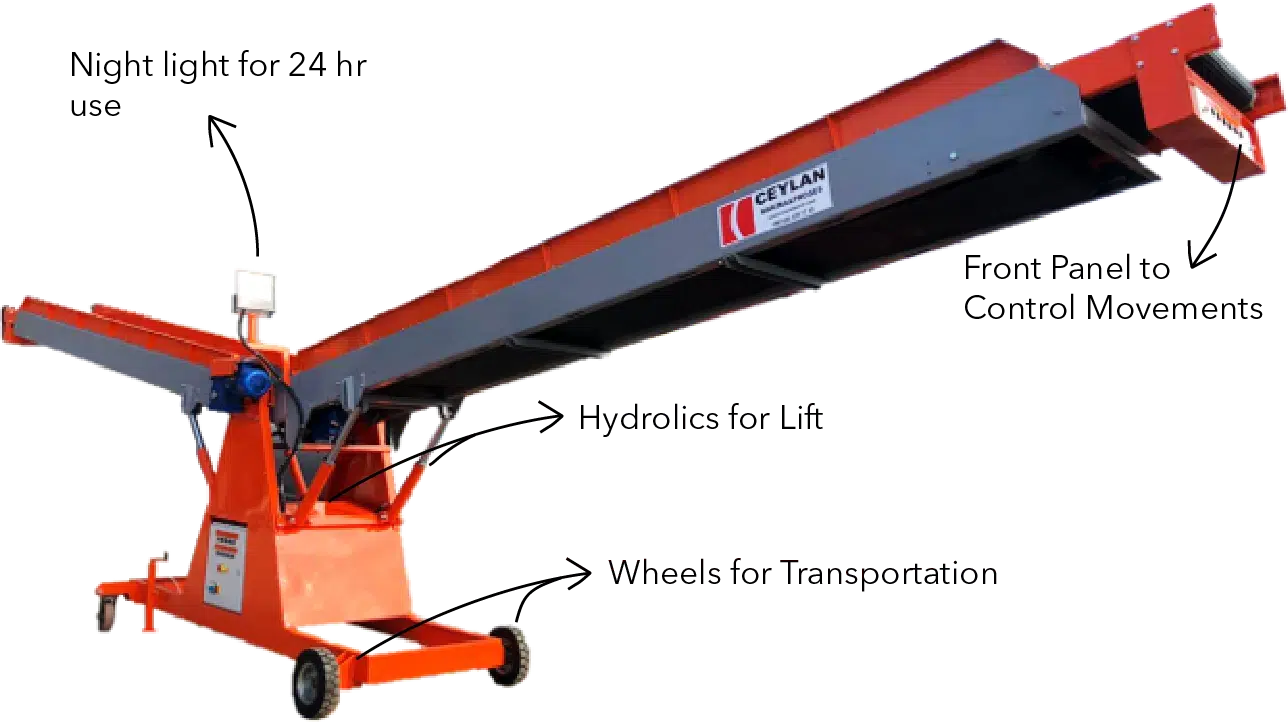
Main Features of the Telescopic Conveyor Belt
- Roulettes pivotantes avec freins pour une meilleure mobilité
- Châssis de convoyeur robuste de 5 mm pour une rigidité et une durée de vie prolongées
- Vitesse variable (VFD) pour un démarrage/arrêt en douceur
- Unité d'entraînement principale de 4 kW pour un fonctionnement fiable
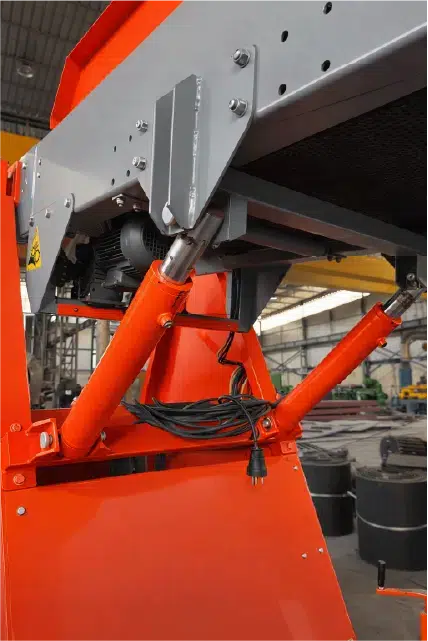
- Vérins hydrauliques pour le levage/l'abaissement (relevage) afin de positionner la courroie à l'intérieur du conteneur
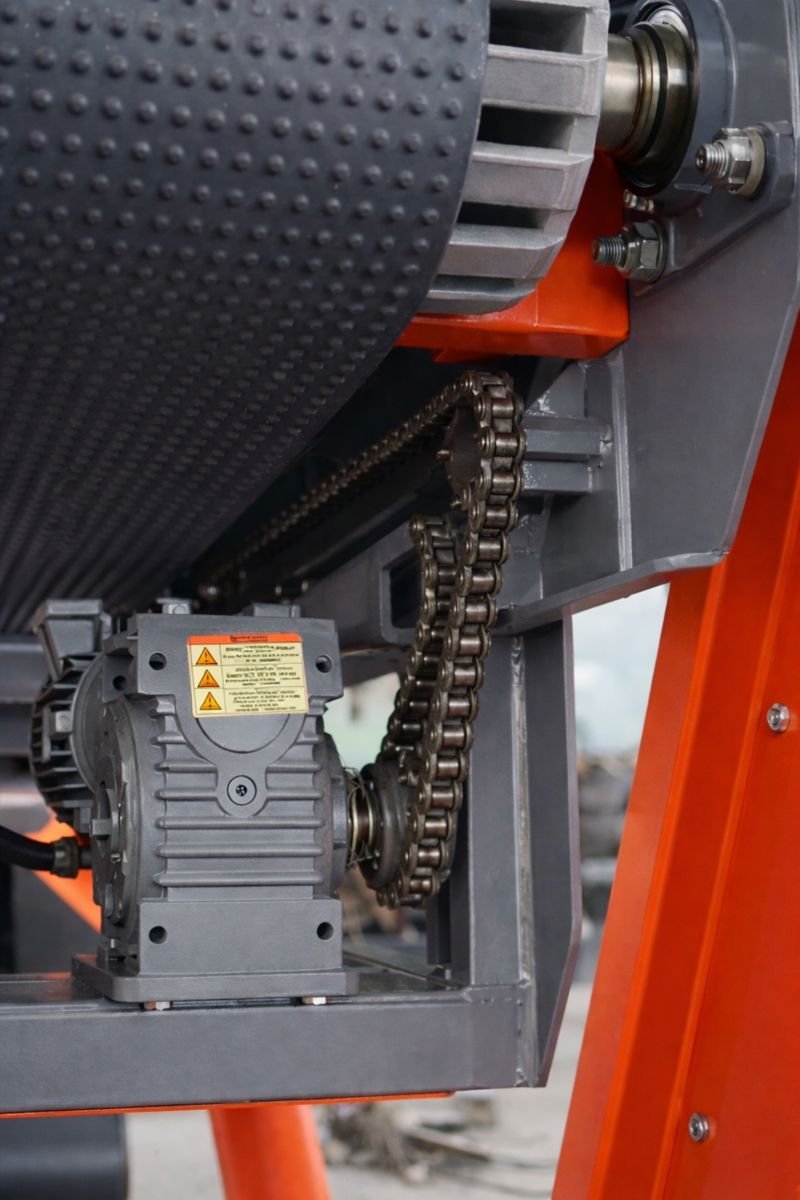
- Déplacement de flèche à entraînement par chaîne avec commande d'entraînement fiable et mouvement fluide
Pourquoi nos convoyeurs télescopiques ont-ils une durée de vie plus longue ?
- Stronger Conveyor Frame : Le châssis de notre convoyeur à bande télescopique est fabriqué en acier de construction de 5 mm d'épaisseur, ce qui lui confère une résistance suffisante aux chutes soudaines de sacs.
- Chains to extend/retract Telescopic Booms : The two-sided conveyor belt has a chain-driven retract system that gives mechanical pull, so the boom retracts smoothly even under varying load, dust, or bag contact, without relying on seal friction or oil pressure.
- Two-sided Telescopic Boom Design : Our two-sided design of the telescopic conveyor belt provides sufficient leverage to work both inside the container and inside the truck. Allows the operator to use the belt as the work distance increases.
- Hydraulic Stability Under Load : Un système de levage contrôlé et un système hydraulique centralisé assurent une levée et une descente en douceur.
Specifications
Main drive power
Length extended/retracted
Drive type of booms
Boom controls
On boom ends/remote
Reach height
Belt speed
Why Choose Our Telescopic Belts?
The defining feature of our telescopic conveyors is that boom extension and retraction are chain-driven rather than hydraulic. A dual-strand roller chain positively couples the drive sprocket to the moving boom section, so travel is governed by a fixed kinematic ratio instead of fluid displacement. In practical terms, every rotation of the drive shaft advances the boom by a known, repeatable distance — the motion is deterministic, not pressure-dependent.
The chain drive is also self-holding under static load, so the boom stays put at any point in its stroke without maintaining hydraulic pressure. Combined with the 5 mm structural-steel frame and centralized hydraulic luffing for lift, the result is a conveyor that positions accurately, holds position reliably, and shrugs off the dust, bag contact, and duty cycle of continuous truck loading — the conditions where sealed hydraulic extension systems tend to degrade first.
Foire aux questions
How far can the telescopic conveyor reach?
Each boom extends and retracts independently, giving an overall span of 23 m fully extended and 12 m retracted, with product delivered up to 4.5 m above ground. Because the unit is double-boom, it can feed two work zones at once — for example a truck on one side and a container on the other — without repositioning the base.
How is the belt speed and loading rate controlled?
The 4 kW main drive runs through a variable-frequency drive (VFD), giving gentle start/stop and adjustable belt speed around the nominal 1.1 m/s. At that speed the conveyor handles roughly 50 bags (50 kg) per minute, and the rate can be tuned to match upstream packing output.
Why is the boom travel chain-driven rather than hydraulic?
Chain drive couples the motor to the boom through direct tooth-to-link engagement, so extension follows a fixed mechanical ratio instead of fluid pressure. Travel stays consistent whether the boom runs empty or loaded, and the drive holds its position without maintaining hydraulic pressure. Hydraulics are reserved for lift and lower (luffing), where controlled pressure is an advantage.