



Running a single blend formula at scale is a relatively straightforward engineering problem. Running ten or fifteen different formulas on the same equipment, week in and week out, in response to variable seasonal demand – that’s where the real design challenge starts. For most agricultural cooperatives and regional distributors, multi-grade flexibility isn’t a feature they’d like to have; it’s a core requirement of the business. The market demands different NPK ratios for different crops, different soil types, and different growth stages, and the blending plant has to be able to switch between them quickly, accurately, and without carrying one formula’s nutrients into the next batch.
We’ll work through the main engineering and operational factors that determine how well a blending facility handles multiple grades: raw material storage, changeover procedures, cross-contamination prevention, dust management, and recipe control.
Raw Material Storage and Bin Design
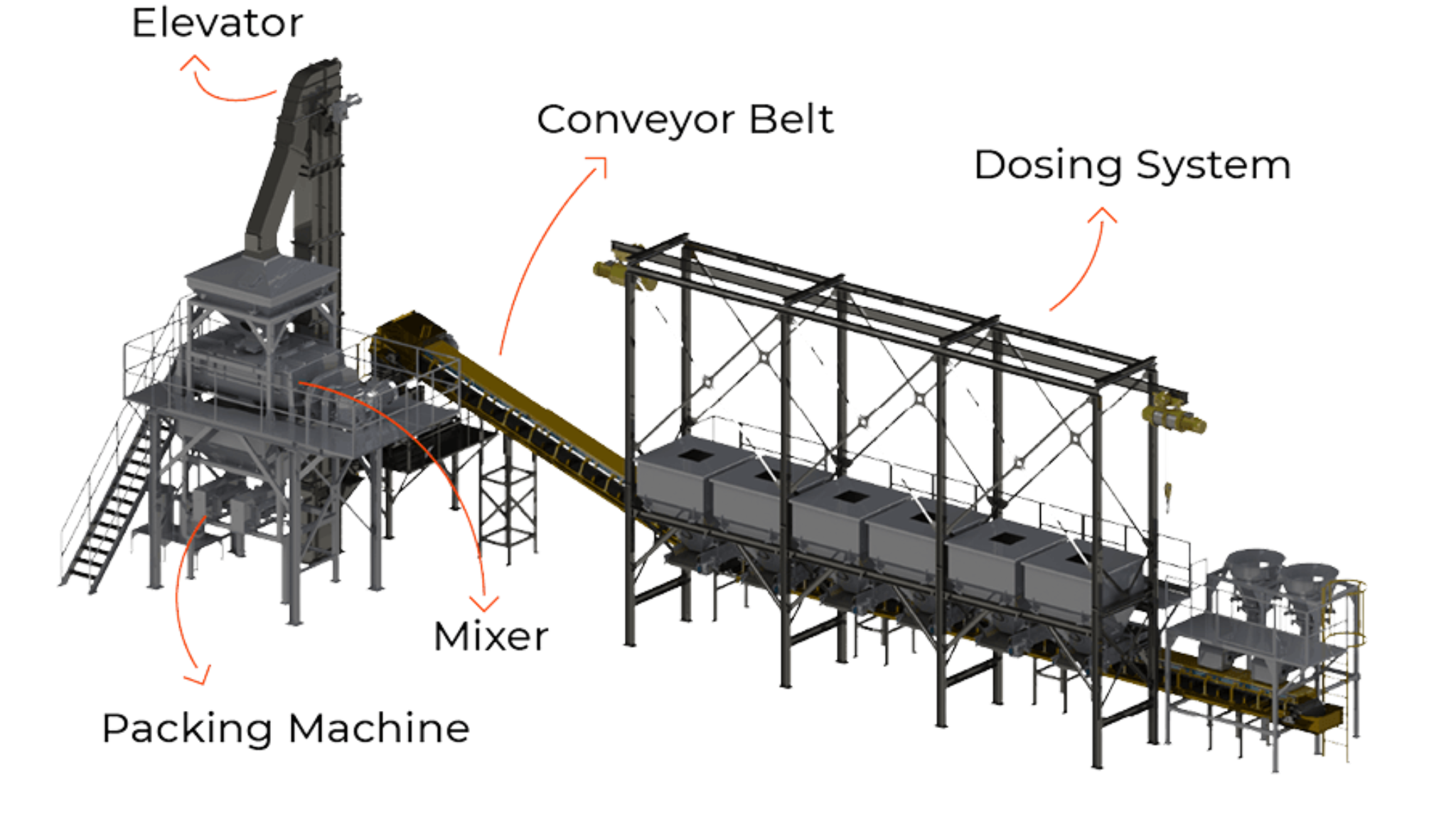
The starting point for any multi-grade blending plant is having the right raw materials available in the right quantities at the right time. The bin structure – the array of storage hoppers that hold individual blending components before dosing – is the physical foundation that makes or breaks multi-grade flexibility.
In a well-designed multi-grade facility, each raw material has its own dedicated storage bin. Urea, DAP or MAP, muriate of potash, sulphate of potash, ammonium sulphate, and any specialist micronutrient or secondary nutrient sources each occupy their own dedicated space, with no mixing or cross-use of bins between materials. This is the cleanest approach from a contamination and changeover standpoint, and it supports the widest range of formula flexibility.
Bin sizing is a balance between holding enough inventory to supply uninterrupted production and keeping the total footprint manageable. The sizing calculation for each bin depends on the consumption rate of that material across the full product range, delivery frequency, and its bulk density and flow characteristics. High-use materials like urea and muriate of potash will typically turn over much faster than a micronutrient source used only in a handful of specialty grades – and their bins need to reflect that difference.
Bin geometry matters too. Hygroscopic and finer-particle materials, such as urea and ammonium sulphate, tend to be more prone to bridging and ratholing than coarser, freer-flowing materials, such as muriate of potash. Bin design for these materials typically incorporates steeper hopper angles, bin activators, or vibration to maintain reliable flow without manual intervention. Getting this wrong tends to show up as inconsistent dosing, particularly for minor components where reliable flow into the feeder is critical to maintaining accuracy.
Changeover Time and Procedures
The time it takes to switch from one blend formula to another is a real operational cost – and in a facility running multiple different grades across a single shift, it adds up. Good changeover procedure design starts at the plant design stage, not the operations stage.
The main variables that determine changeover time are: how different the component mix is between the outgoing and incoming formulas; how much residual material needs to be cleared from the common dosing and conveying lines; whether the mixer requires flushing between grades; and how the recipe changeover is managed in the control system.
In a well-designed plant, switching formulas that share the same component materials – moving from a 15-15-15 to an 18-10-10, both using urea, MAP, and MOP – can be done quickly once the weigh hopper and conveying lines are clear. Switching to a formula that introduces a new component, or one that carries a contamination risk for the next product, requires a more thorough flush and inspection before production can restart. Building that variability into the operational scheduling is important: not all grade transitions take the same amount of time, and production planning that treats them as interchangeable tends to underestimate the real cost of multi-grade operation.
Cross-Contamination Prevention
Cross-contamination in a dry blending plant is a physical rather than chemical problem – but its commercial consequences can be significant. A trace of the previous batch’s formula in the first bags of the next run means the declared nutrient analysis on those bags may not be accurate, which creates a customer quality issue and potentially a regulatory one.
The main contamination pathways are the common conveying and weigh hopper lines shared between all formulas, the interior of the mixer itself, and the bagging and dispatch equipment downstream. Managing contamination risk requires a combination of equipment design choices and operating procedures: conveyor and chute designs that minimise dead zones where material can accumulate; mixer types that discharge cleanly without leaving significant residue in the mixing chamber; and a defined flush procedure – typically running a small quantity of one of the next batch’s components through the common lines before the batch proper starts.
Some operations manage this risk by scheduling similar formulas back-to-back – grouping grades that share the same component materials together in the production sequence so that any carry-over from one batch to the next has negligible impact on the declared analysis. This kind of production sequencing logic is most effective when it’s built into the plant’s scheduling and recipe management system rather than left to shift-level decision-making.
Dust Management During Grade Changes
Grade changeovers tend to be among the higher dust-generating activities in a blending plant. Emptying and refilling bins, clearing conveying lines, and – in some configurations – opening access points for inspection or cleaning all create dust release opportunities that are less prevalent during steady-state production.
Managing dust during changeovers requires the same engineering controls as during production – enclosures, aspiration, and filtration – but with particular attention to the bin tops and connection points that may be disturbed during the changeover process. A well-designed access arrangement for the bin tops and conveyor discharge points, with aspiration active during those operations, is one of the practical things that distinguishes a plant designed with multi-grade operation in mind from one designed purely for single-product throughput.
PLC Recipe Management
The control system is what ties multi-grade operation together. A modern blending plant PLC stores the full approved recipe library – every formula with its component list, target weights, tolerances, and any special sequencing requirements – and manages the production workflow around that library.
When an operator initiates a new batch, they select the formula from the approved list, confirm the batch size, and the system steps through the dosing sequence automatically. The control logic prevents manual overrides that could introduce unauthorised formula modifications, maintains a live batch record for every production run, and generates the documentation that links each bag of product to the batch and raw material lots that went into it.
A well-configured recipe system also supports formula versioning – the ability to maintain historical records of what was produced under a given formula code, even as the formula is updated between seasons. For cooperatives and distributors who supply product to customers with their own quality management requirements, this kind of traceable batch history is increasingly a commercial necessity rather than just a regulatory obligation.
Ceylan Machine & Process designs and engineers multi-gradebulk blending facilities, including bin array configurations, automated dosing systems, and PLC recipe management. For technical enquiries or to discuss your product range requirements, contact our engineering team.