



Both loss-in-weight and weigh-belt systems are gravimetric dosing technologies; they both measure actual mass rather than volume, and they both compensate in real time for changes in material density, moisture, and particle characteristics. In this fundamental respect, they are alike, and both represent a substantial improvement over volumetric dosing for any application where formulation accuracy matters. But they achieve gravimetric control through different mechanisms, and those different mechanisms produce different performance characteristics, different capital and maintenance costs, and different best-fit applications. Choosing between them based on headline accuracy specs alone tends to produce the wrong answer: the decision is more nuanced than that.
We’ll compare the two technologies across accuracy, capital cost, throughput, cleaning, maintenance, and application fit, so engineers and procurement teams can match the technology to the actual requirements of their fertilizer batching application.
How Each System Actually Works
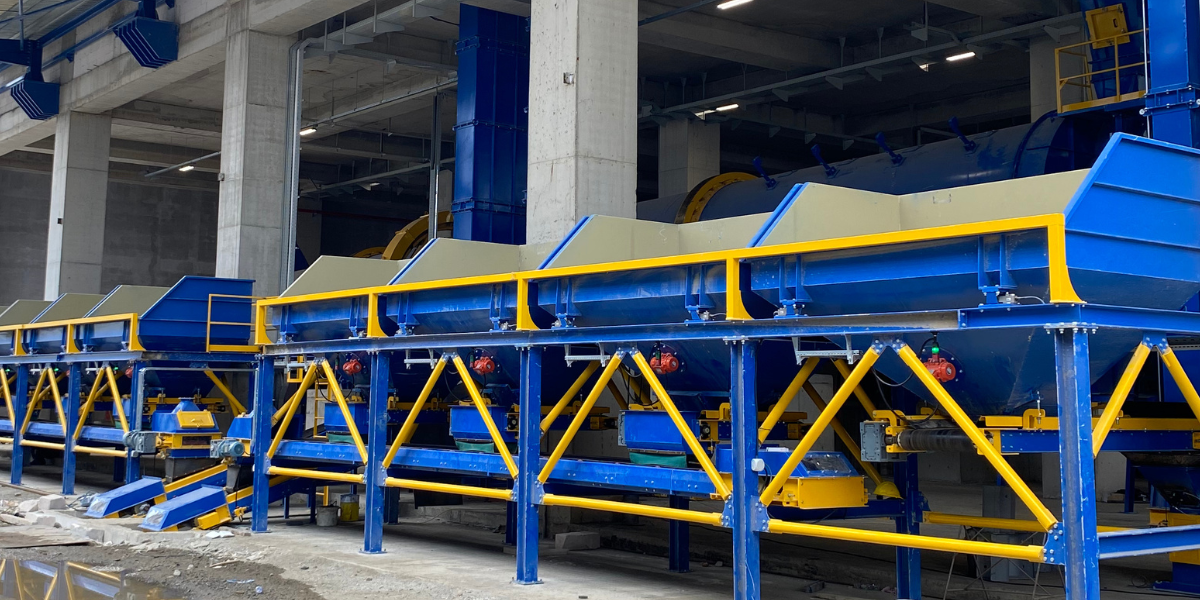
In a loss-in-weight (LIW) system, the feeder and its supply hopper sit together on a set of load cells. The control system continuously monitors the total weight and calculates the rate at which weight is decreasing as material is discharged. It compares this measured rate of weight loss against the target feed rate and uses a VFD to adjust feeder speed, faster when the actual rate is below the setpoint, slower when above, to maintain the target mass flow within the control tolerance.
The defining characteristic of the LIW approach is that it controls feed rate from the measurement of actual material weight in real time. If the material’s bulk density changes — because the urea has absorbed moisture and its apparent density has shifted, because the pile angle in the hopper has changed, or because the particle size distribution of a recycle stream has varied — the controller detects the effect immediately as a change in the rate of weight loss and compensates before an error accumulates.
In a weigh-belt system, a belt conveyor carries material over a section fitted with load cells, which measure the weight of material on a defined belt length. A speed encoder measures belt velocity. The control system multiplies weight per unit length by belt speed to calculate instantaneous mass flow rate, and adjusts the belt speed or the upstream feed rate to hold the target. The belt is the measurement platform rather than the hopper.
The defining characteristic of the weigh-belt approach is that it is inherently continuous — material flows uninterrupted from the supply to the downstream process without a refill cycle — and that it handles high volumetric throughput well because the belt can carry large quantities per unit time. The limitation is that the accuracy of the mass flow calculation depends on consistent material distribution across the belt and on accurate belt tension, and both of these can be affected by variable material properties in ways that are harder for the control loop to compensate for than the equivalent density change in an LIW hopper.
Accuracy
In applications where conditions are stable, consistent material density, consistent particle size distribution, uniform belt loading, both technologies can achieve high accuracy. The difference becomes apparent when conditions vary.
LIW systems maintain their accuracy across a broader range of material condition changes because the measurement is direct: the weight of material in the hopper is measured explicitly, and the rate of change of that weight is the control signal. Changes in bulk density don’t affect the measurement directly; they affect how quickly the hopper empties, which is exactly what the controller is tracking. A well-calibrated LIW system with a stable load cell installation typically achieves mass flow accuracy in the range of ±0.25% to ±0.5% of setpoint across the full operating range, depending on feeder type, material properties, and the accuracy of the calibration routine.
The LIW system has one period where direct gravimetric control is temporarily unavailable: the refill cycle. When the hopper falls below its minimum level and needs to be refilled, the load cells cannot distinguish refill material from the controlled feed, and the controller must switch to volumetric mode, holding the last known good feed rate, for the duration of the refill. In a well-designed system, the refill is triggered at the right level and the volumetric hold period is short. In a poorly designed or inadequately maintained system, the refill cycle can introduce a systematic error that is large relative to the nominal accuracy specification.
Weigh-belt systems achieve accuracy in the range of ±0.5% to ±1.5% of setpoint under stable conditions, though the range widens with variable material , non-uniform loading across the belt width, fluctuating bulk density, or belt slip, all of which introduce measurement error that the control loop may not fully correct for. No refill cycle interrupts the measurement, which is an advantage for continuous high-throughput applications where the brief LIW hold period would represent a meaningful fraction of total production time.
Capital Cost and Footprint
Weigh-belt systems are typically lower in capital cost than LIW systems of comparable throughput, principally because the primary capital item — a belt conveyor with load cells — is mechanically simpler than a hopper-mounted feeder system with load cell isolation and a controlled refill system. For high-volume dosing of a single bulk component where absolute accuracy is less critical than throughput, the weigh-belt represents a better return on capital investment.
LIW systems carry higher capital cost, reflecting the more complex mechanical assembly of the hopper, feeder, and load cell mounting, the need for refill equipment, and the more sophisticated control loop required to manage the refill cycle and maintain accuracy across varying material conditions. The cost premium is most justified for multi-component formulations where each component needs to be dosed accurately and the formula cost of error (overdosing expensive micronutrients, for example) is high relative to the equipment cost difference.
Footprint: LIW systems tend to have a larger vertical footprint (hopper height plus feeder depth plus load cell clearance below) but a more compact horizontal footprint than an equivalent-throughput weigh-belt. For plants where headroom is the installation constraint, LIW can be difficult to fit. For plants where horizontal space is the constraint, weigh-belt installations can be awkward to lay out.
Cleaning and Changeover
For fertilizer plants running multiple product grades, the cleaning and changeover behaviour of the dosing system has a direct impact on the time between grades and the risk of cross-contamination.
LIW hoppers are enclosed systems, which is an advantage from both a dust management and a cleanout standpoint: the material is contained throughout the dosing process, reducing fugitive dust and simplifying the containment of a single material in a defined volume. Hopper cleanout requires opening the hopper and removing residual material from the cone and feeder, the 32–36° slope angle on a well-designed hopper supports gravity discharge of free-flowing materials, but cohesive materials may require manual assistance. In a multi-product plant with frequent grade changes, the time to clean a hopper between grades and verify that no cross-contamination risk remains is a real operational cost.
Weigh-belt systems are inherently harder to clean thoroughly because the belt surface, the belt edges, and the transfer point between the belt and the downstream conveyor all collect material, and cleaning any moving surface completely is more time-consuming than cleaning a smooth conical hopper. For plants where the same high-volume component runs continuously and grade changes don’t require the belt to be cleaned between runs, this is not a significant constraint. For multi-product toll blending or fertilizer plants with frequent grade changes involving different major components, the cleaning burden of a weigh-belt can be more significant than its capital cost advantage suggests.
Maintenance
The maintenance profile of LIW systems centres on three items: load cell calibration and condition, feeder wear parts, and refill system reliability. Load cells drift over time and should be verified against a known calibration weight on a defined schedule, the frequency depends on the throughput and the material, but quarterly verification is a common starting point for continuous fertilizer dosing applications. Feeder wear parts — screw flights, belt surfaces — follow the normal replacement schedule for the feeder type and material abrasiveness. Refill system components (valve actuators, level sensors) are typically low-maintenance, but their correct function is important enough to warrant inclusion in the routine inspection checklist.
Weigh-belt maintenance centres on belt tension and tracking, load cell cleanliness (spillage under the belt can contact the load cells and introduce measurement error), and belt condition. Belt tracking problems and material spillage under the belt are the most common causes of weigh-belt accuracy degradation in fertilizer applications, and both require prompt attention. In a dusty or wet environment, keeping the load cell area clean requires more active management than in a dry, enclosed installation.
When to Choose Each
LIW is typically the stronger choice when: accuracy across varying material conditions is the primary requirement; the formula contains expensive minor components where dosing error has a high direct cost; the installation handles multiple material types from the same feeder; or the regulatory or quality management context requires an audit trail of individual batch weights for each component.
Weigh-belt is typically the stronger choice when: the application is high-volume continuous dosing of a single bulk component with consistent properties; capital cost minimisation is the primary procurement constraint; accuracy at the ±0.5–1% level is sufficient for the application; or installation head room is limited and the vertical depth of an LIW system cannot be accommodated.
For multi-component NPK granulation dosing where each of the major nutrient sources (urea, DAP or MAP, muriate of potash, and any micronutrient sources) needs to be dosed accurately and the control system needs to compensate for variable material properties, the LIW approach tends to be the more appropriate technology. For a single high-volume recycle conveyor or a bulk filler stream where throughput rather than precision is the primary requirement, a weigh-belt can be the right fit at lower cost.
Ceylan Machine & Process manufactures loss-in-weight dosing systems for NPK, DAP, MAP, and custom fertilizer formulation lines, with 0.2–0.5% precision, VFD-controlled feeders, and PLC/HMI integration. For technical enquiries on dosing system selection for your application, contact our engineering team.