




Materials selection in a MAP/DAP fertilizer plant is not a uniform specification exercise. The process moves through several distinct chemical environments: concentrated wet-process acid in feed systems, hot acidic ammonium phosphate slurry in reaction and granulation, hot dry product in drying and cooling, abrasive dust in gas handling, and the material that handles one zone well can fail rapidly in another. Getting the selection wrong in a critical location doesn’t always cause a dramatic immediate failure; it tends to produce a progressive degradation that shows up as a maintenance burden and then as an unplanned shutdown when the wall thinning or the weld decay finally reaches a failure point.
We’ll cover the corrosion and erosion challenges by process zone, the materials logic that addresses each zone, and the practical trade-offs between capital cost and service life that govern the selection decisions.
Understanding the Corrosion Environment
MAP/DAP production creates several distinct corrosion environments that coexist in proximity and require different material responses.
Wet-process phosphoric acid is weakly corrosive at dilute concentrations but becomes substantially more demanding at the concentrations used in fertilizer production (typically 40–54% P2O5 by weight). It also contains impurities, fluoride compounds, sulfate, dissolved iron, aluminium, and magnesium, that complicate the corrosion picture. Fluoride from the phosphate rock attack creates HF in the acid, which attacks silica-containing materials and adds to the corrosion burden on metallic surfaces. Sulfate from the sulfuric acid used in rock dissolution creates additional corrosion potential at elevated temperatures.
Ammonium phosphate slurry in the preneutralizer and granulator feed zone is hot (typically 90–120°C depending on the process configuration), viscous, and acidic relative to the final product composition. The combination of heat, acidity, and slurry abrasion (from suspended solids and granule fragments in the granulator) is among the most demanding environments in the plant for equipment in contact with process materials.
Hot gas streams in the dryer, rotary cooler, and scrubber exhaust carry fine product dust, water vapour, ammonia, and fluoride compounds. The combination of humidity, fluoride, and acid aerosols in cooling zones of the gas path creates a condensation corrosion risk wherever the gas temperature falls below the dew point.
Dry product zones, the bulk of the dryer barrel, the cooler, the screener, and the crusher, are less chemically aggressive but are subject to abrasive wear from the granule cascade and the screen operation.
Phosphoric Acid Storage and Feed Systems
Wet-process phosphoric acid at merchant-grade concentration (approximately 40–54% P2O5) requires rubber-lined carbon steel or high-density polyethylene (HDPE) for storage tanks at ambient temperature. Carbon steel in direct contact with merchant-grade WPA corrodes at unacceptable rates even at ambient temperature; rubber lining provides the primary corrosion barrier, with the steel providing structural support.
For acid feed lines operating at higher temperatures or where the rubber lining approach is impractical, corrosion-resistant alloys are used. 316L stainless steel is adequate for dilute acid service (below approximately 30% P2O5) at ambient temperature, but at higher concentrations and temperatures the chloride and fluoride impurities in WPA can cause pitting and crevice corrosion in 316L. Higher-alloy grades , 317L, Alloy 20 (UNS N08020), or duplex stainless steels such as 2205, provide better resistance in concentrated WPA service at moderate temperatures. For hot concentrated acid service, exotic alloys or rubber lining on metallic substrates may be the more cost-effective solution depending on the specific conditions.
Pumps handling WPA slurries or hot acid require impeller and casing materials with both chemical and abrasion resistance. Rubber-lined carbon steel casings with natural rubber-covered impellers, or centrifugal pumps with high-chromium white iron wetted parts, are common approaches in acid slurry service.
Preneutralizer and Reaction Sections
The preneutralizer sees the most concentrated combination of corrosion factors: hot temperature (typically 100–120°C depending on process design), ammonium phosphate slurry with residual free acid, and the direct contact of both the acid and ammonia feeds. The vessel shell is typically rubber-lined carbon steel, with the rubber selected for compatibility with the temperature and the chemical environment. Natural rubber performs well in phosphoric acid service at moderate temperatures; EPDM or neoprene are alternatives depending on the specific temperature and chemical exposure. The rubber lining must be continuous and well-bonded to the shell to prevent acid penetration to the steel substrate; a pinhole or edge disbondment in the lining is a failure point that propagates quickly in hot acid service.
Agitator shafts and impellers in the preneutralizer require metallic construction that can withstand both corrosion and the mechanical loads of stirring a dense slurry. Stainless steel grades in the 316L or higher range are commonly used, with consideration of the actual pH and temperature at the mixing zone. The shaft seals must be compatible with the slurry chemistry and designed for easy maintenance, since this is a high-wear component in continuous service.
Pipe reactor internals are exposed to the sharpest conditions in the plant; the reaction zone where acid and ammonia first contact is at the highest temperature and the most chemically active. Reactor tube materials are often high-alloy stainless steels or nickel alloys, depending on the specific process temperatures and acid compositions. The interior of a pipe reactor is not usually accessible for inspection during operation, which places a premium on material selection that provides reliable service without requiring frequent replacement.
Granulator: Feed End vs. Discharge End
The granulator barrel presents a gradient of conditions from the feed end (wet, hot, acidic slurry contact) to the discharge end (drier, cooler, less chemically aggressive). The material selection for the granulator reflects this gradient.
The shell is typically lined with EPDM rubber throughout, which provides both chemical protection and the resilient surface that prevents granule adhesion to the steel. The rubber liner specification for the granulator should be validated against the specific slurry chemistry being used. In MAP service, where the slurry environment is more acidic than in DAP service, the rubber grade selection requires more attention to acid resistance.
Spray nozzles and liquid distribution components in the granulator that contact the hot acid slurry directly are often made from stainless steel grades with higher corrosion resistance than 316L, Alloy 20, 2205 duplex, or in some cases nickel-based alloys for the highest-acid-contact areas. These components are also wear items that require periodic replacement, so the plant design should facilitate easy access and removal.
The internal lifter plates that provide the bed-cascade action are rubber-covered and primarily subject to abrasive wear rather than chemical attack in the mid-drum and discharge zones. Their replacement frequency depends on the granule hardness and the throughput.
Dryer and Cooler
The rotary dryer barrel in the feed zone (where the hot gas first contacts the wet granules) sees the combination of hot, moist, slightly acidic gas and wet granule surface. In this zone, the internal surface may be rubber-lined or constructed from corrosion-resistant steel, depending on the design temperature and the acid loading in the gas. Further along the dryer barrel, as the product dries and the gas temperature drops, the environment becomes less aggressive and carbon steel is typically adequate.
The cooler operates with cooler air and dried product, and is typically constructed from carbon steel without special lining. Gas-side surfaces in the cooler exhaust path may see acid condensation if the gas stream contains fluoride or acid aerosols from the dryer; these areas should be lined or coated to resist the condensate chemistry.
Cyclones, Bends, and Gas Handling
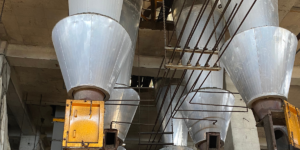
Cyclone separators in the gas handling system see high-velocity dust-laden gas and are subject to erosion at the outer wall of the cyclone body and at the top inlet. Abrasion-resistant liners, typically high-chromium cast iron, ceramic tile, or rubber-lined construction, extend cyclone service life in high-dust applications. The specific choice depends on the gas temperature and the particle characteristics: rubber lining handles moderate temperatures well and provides excellent abrasion resistance, but is unsuitable for the very high temperature zones immediately downstream of the dryer.
Gas handling ducting, particularly in runs where slurry aerosol or acid condensate can contact the duct wall, is rubber-lined or FRP (fibre-reinforced polymer) construction depending on the temperature. Carbon steel ducting in these locations corrodes rapidly and is typically avoided.
Scrubbers and Gas Treatment
Wet scrubbers in the gas treatment system handle a combination of ammonia, fluoride, acid aerosol, and fine product dust in a water or dilute acid liquor environment. The scrubber vessel and internal packing or spray nozzles are typically constructed from polypropylene (PP), FRP, or rubber-lined steel, depending on the temperature and the composition of the scrubber liquor. Metallic construction in scrubbers using acid liquor requires corrosion-resistant alloys or lining.
Ceylan Machine & Process designs MAP/DAP fertilizer production facilities with zone-specific material selection for corrosion and wear resistance. For technical enquiries on materials of construction for your plant conditions, contact our engineering team.