



Liquid and granular fertilizer production are not directly competing routes to the same market. They tend to serve different buyers, different application methods, and different geographic distribution patterns, and the production economics that make one route attractive are often the exact characteristics that make the other unsuitable for a specific market context. The decision between them, or the question of whether to combine both, is primarily a market positioning and logistics question rather than a technical one, though the technical differences in production and storage have a significant bearing on what the economics look like.
We’ll compare the two routes across capital cost, operating cost, product stability, transport economics, and end-market demand, and give buyers and producers a framework for thinking through which route fits their situation.
Capital Expenditure
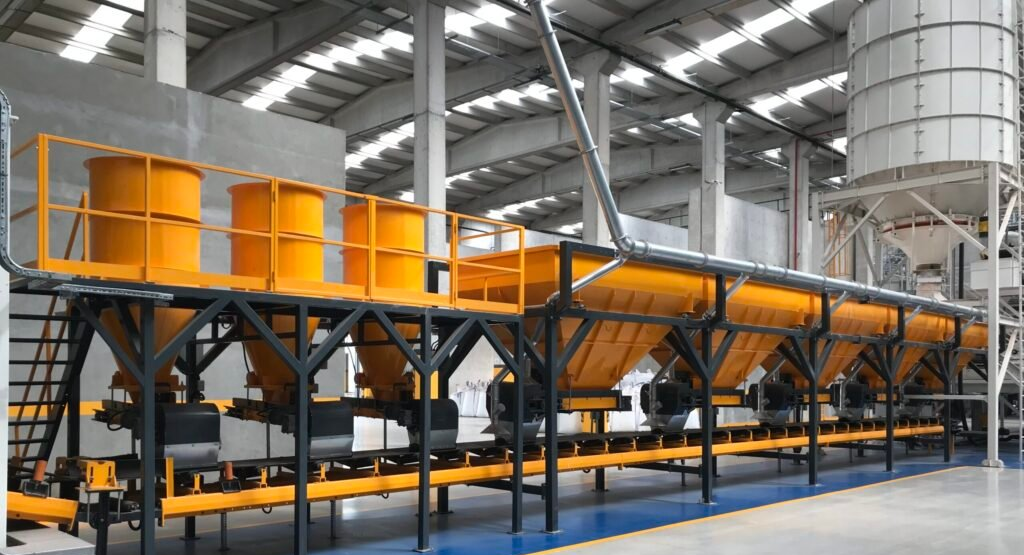
The capital cost of a liquid fertilizer production line is typically substantially lower than a granular production facility of comparable nutrient output capacity. Granular production, whether by drum granulation, pan granulation, or prilling, requires a granulator, a dryer, a cooler, screening equipment, a crusher, dust collection infrastructure, and the civil works to house and support a complex, thermally intensive process. A liquid fertilizer line requires mixing tanks, agitators, pumps, filtration, storage tanks, and filling stations. The equipment list is shorter, the civils are simpler, and the utility requirements (heat and power) are lower.
The capital advantage of liquid production is most pronounced at lower production capacities. A liquid NPK line producing a few thousand tonnes of nutrient equivalent per year can be installed for a fraction of the cost of a granulation plant at the same nutrient output, and the startup complexity is lower. As capacity scales up, the capital gap narrows somewhat; large liquid production systems with high-speed filling lines, multiple storage tanks, and large-volume agitators are not inexpensive, but the liquid route remains generally lower in capital intensity than its granular equivalent at comparable throughputs.
One consideration that partially offsets the liquid production capital advantage is storage. Liquid fertilizers require corrosion-resistant storage tanks in sufficient volume to buffer production, hold seasonal inventory, and handle the receiving of liquid raw material inputs where applicable. These tanks represent capital that a granular plant doesn’t need in the same form; a granular plant’s product inventory sits in a warehouse, which is generally cheaper to build than an equivalent volume of stainless or coated steel tankage.
Operating Expenditure
Energy cost is lower in liquid fertilizer production than in granular production of comparable capacity. The energy-intensive steps in granular production, drying and, to a lesser extent, the dryer burner fuel cost, are absent in liquid production. The primary energy demands in a liquid plant are agitation (electric motors) and pumping, both of which are much less energy-intensive than thermal drying.
The raw material cost picture is more complex and tends to work in the opposite direction. Fully water-soluble fertilizer grades, the raw materials needed to produce clear NPK solutions without insoluble residue, are priced at a premium over standard granulation-grade materials. Technical-grade monopotassium phosphate, water-soluble potassium nitrate, and chelated micronutrient sources cost more per unit of nutrient than the bulk commodity grades used in granulation. The operating cost advantage from lower energy is frequently offset, partly or fully, by the higher raw material cost of water-soluble input grades.
Labour requirements in a liquid plant tend to be lower per tonne of product output than in a comparably sized granulation plant, reflecting the simpler process and the lower maintenance burden of a plant without rotating thermal equipment. However, this comparison is sensitive to the degree of automation in each plant; a manual granulation line may use less labour per tonne than a highly automated liquid line with a large SKU range and frequent changeovers.
Product Stability and Storage
Granular fertilizers are inherently stable in dry storage. Caking is the main storage quality problem, and it’s manageable with appropriate conditioning additives, low-moisture production, and suitable storage conditions. Well-made granular product can be stored for extended periods, months to years in some cases, and shipped long distances without significant quality deterioration.
Liquid fertilizers have more complex stability requirements. The primary stability risks are crystallisation at low temperatures and pH-driven precipitation of certain nutrient forms, particularly phosphate in the presence of calcium or certain micronutrients.
Crystallisation: many NPK solution formulas become unstable at low temperatures and will crystallise when ambient temperature drops below the solution’s crystallisation point. The crystallisation temperature depends on the formula concentration and the specific nutrients in the product; a more concentrated formula crystallises at a higher temperature than a more dilute one. For liquid fertilizer production in markets with cold winters, either formula concentration must be designed around the expected storage temperature, or heated storage and transport must be provided. This represents a real operational constraint and infrastructure cost in cold climates that does not apply to granular product.
Precipitation: certain nutrient combinations in solution are thermodynamically unstable and will precipitate a solid phase over time. Calcium with phosphate or with sulfate is the most common incompatibility; calcium phosphate and calcium sulfate are both sparingly soluble, and their precipitation produces a solid deposit that can block pipes, filters, and spray nozzles. The dissolution sequence during production and the selection of compatible raw material grades are the primary controls on this risk. Stabiliser additives, typically acids to lower pH and keep phosphate in solution, are used in some formulas to extend shelf life.
Transport Economics
This is the most decisive factor separating the economic viability of liquid and granular production for a specific market, and it tends to dominate the comparison as distribution distance increases.
Liquid fertilizer contains water, typically between 30 and 60% of the product mass by weight, depending on formula concentration and whether the product is a solution or a suspension. Every tonne of liquid product shipped carries a substantial non-nutrient water payload. Granular fertilizer contains no water (or negligible moisture), so the ratio of nutrient to transport cost is much more favourable for granular product at any given nutrient concentration.
For local distribution, supplying farms and distributors within a relatively short radius of the production site, this water weight penalty is manageable and the lower capital and operating costs of liquid production can make the overall economics work. For regional or export distribution, where transport costs compound over longer distances, the water weight penalty becomes progressively more significant and the granular route begins to dominate on a delivered-cost-per-unit-of-nutrient basis.
The break-even distribution distance, the radius within which liquid production is competitive with granular on a delivered nutrient cost basis, depends on transport costs, the specific nutrient concentrations involved, and the price premium that liquid products command in the market. This varies by region and market but is a calculation worth performing with realistic local transport costs before making a commitment to either production route.
End-Market Demand
Liquid fertilizers serve a different application context from granular. The primary demand drivers for liquid NPK and water-soluble products are:
Fertigation and drip irrigation: crops grown under drip irrigation, vegetables, fruits, ornamentals, greenhouses, apply fertilizers through the irrigation system. Only fully dissolved, particle-free fertilizers can pass through the emitters without blocking. This market segment requires fully water-soluble products and commands a significant price premium over commodity granular NPK.
Foliar application: spraying dilute fertilizer solutions onto crop foliage as a supplemental nutrient delivery method is used for micronutrients and for correction of specific deficiencies. Liquid fertilizers formulated for foliar application need to be clean, leaf-compatible, and at appropriate pH.
Liquid blending for broadacre application: in some markets (most prominently North America), liquid NPK solutions are blended and applied to fields by specialist liquid applicators as part of standard crop nutrition programmes. This is a volume market and is more price-sensitive than the fertigation segment.
The relative importance of these segments varies significantly by geography. In North America, liquid fertilizer penetration in broadacre agriculture is substantial. In Africa and much of the Middle East, the liquid fertilizer market is primarily in the fertigation and specialty crop segment and is still developing. European markets have established liquid fertilizer supply chains for horticulture. For producers evaluating liquid production, the local market structure for each of these segments is the primary input to the demand forecast.
Complementarity: Running Both Routes
Many established fertilizer producers operate both granular and liquid production as complementary rather than competing lines. The granular plant handles the high-volume commodity demand from broadacre crops; the liquid line handles the specialty and precision agriculture segment. The two lines can share raw material supply relationships, sales infrastructure, and sometimes storage and logistics assets.
For a producer who already operates a granular facility, adding a liquid line typically represents a lower-risk investment than starting from scratch with liquid production, because the raw material procurement and sales channels are already partly in place. The incremental capital for a liquid line on an existing granular site is also lower than a standalone greenfield liquid plant, since some infrastructure (power, water, logistics access) is shared.
For a project evaluating liquid production as the starting point, the key questions are whether the local distribution radius supports the economics of shipping water-weight product, whether the target market segment (fertigation vs. broadacre liquid) has sufficient demand depth, and whether the raw material supply for water-soluble grades is accessible at commercially viable prices.
Ceylan Machine & Process designs and delivers turnkey liquid fertilizer production lines, including dosing, dissolution, filtration, storage, and filling systems. For technical enquiries on production system design or to discuss whether liquid production fits your market, contact our engineering team.