




Rotary Coolers
In high-tonnage granulation plants, cooling is where you find out if the product will pour cleanly or sit in the silo as a glued-up mess. Once it leaves the dryer, the granules stay hot enough to cause condensation in chutes, storage, and bags, and that stray moisture causes trouble fast.
As rotary cooler manufacturers, Ceylan Machine & Process builds rotary coolers for chemical fertilizer plants that need stable, predictable discharge temperatures at scale.
In a typical NPK or MAP/DAP line, a counter-current rotary cooler brings granules down close to ambient so they can be coated, conveyed, and stored without taking on moisture to itself.
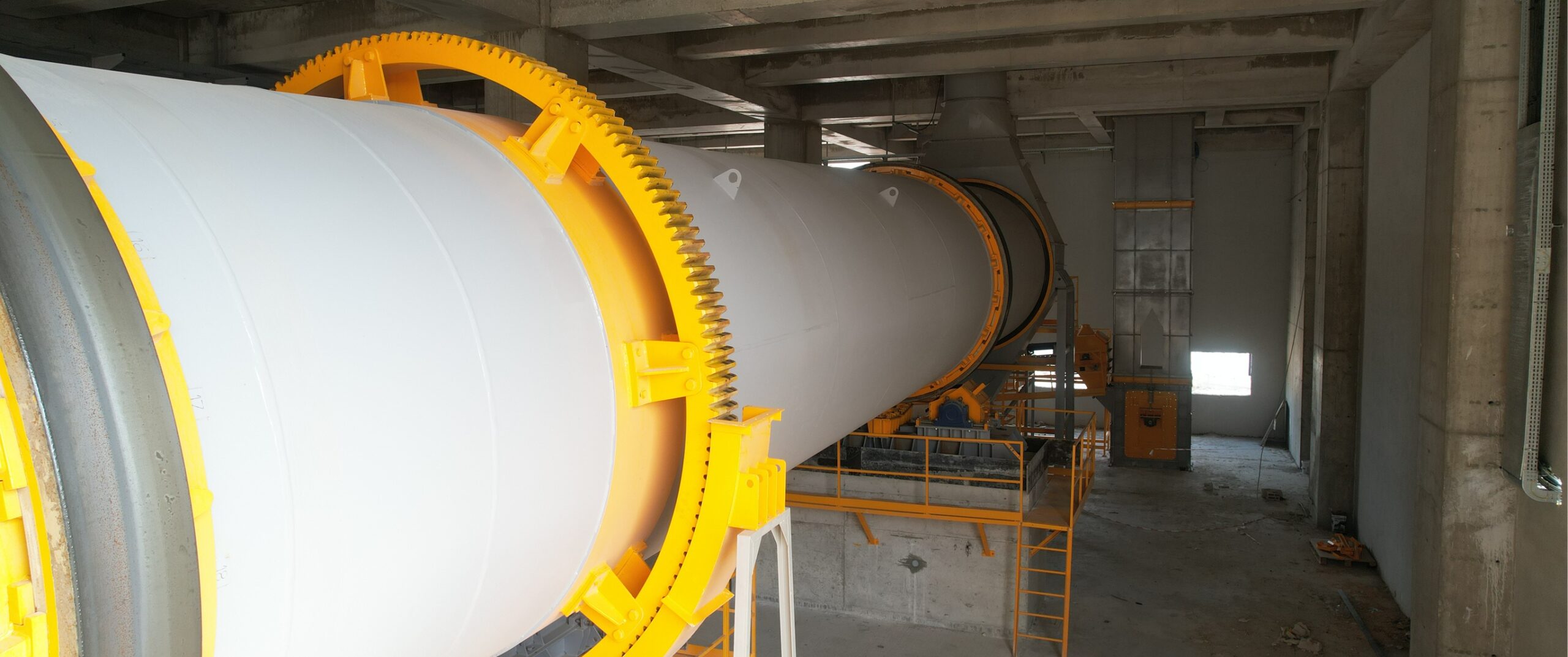
Built for the abrasive, corrosive reality of a fertilizer plant: thick-walled shell, forged riding rings, and a shell specification matched to your grade and load — not a generic catalog build.
Flights lift the bed and drop it as a continuous curtain, so every granule meets fresh air instead of sitting buried in a static pile. Discharge temperature holds near target across grade changes — not just at the design point.
Ambient air enters at the discharge end and leaves at the feed end. The coldest product meets the coldest air, which is what lets the granules actually approach ambient instead of stalling out 15 °C above it.

Description
Where the cooler sits, and what it is actually for
Granulator → Rotary dryer → Screens → (oversize to crusher, undersize to recycle) → Rotary cooler → Coating drum → Storage / bagging
Cooling only the on-size fraction is deliberate: there is no point spending air, fan power and shell volume on material that is about to go straight back to the granulator as recycle.
The cooler’s job is to remove sensible heat, not moisture. Granules typically leave the dryer at 70–95 °C. Send them to storage like that and three things happen:
- Caking. A hot pile cools slowly and unevenly. Moisture migrates toward the cold faces, salts dissolve and recrystallise at the contact points between granules, and solid bridges form. What went into the silo free-flowing comes out as a slab.
- Moisture pick-up. The critical relative humidity (CRH) of fertilizer salts falls as temperature rises — and a mixed NPK grade has a far lower CRH than any of its components on their own. A hot granule will pull water out of ambient air that a cool granule would ignore.
- Bag sweat. Hot product sealed in a PE bag drives moisture to the bag wall, where it condenses and runs back into the product. The bag reaches the farmer caked.
Principales caractéristiques et avantages :
- Built for abrasion and condensation:
a cooler’s real enemies. A cooler’s failure modes are not a granulator’s. The bed is dry, so buildup is rarely the issue; abrasion from tumbling granules and corrosion where humid cooling air meets cold steel are. Shell thickness, lining and material grade are specified against your formulation and chloride load. Forged riding rings carry the shell; automatic grease-spray lubrication keeps the gear mesh healthy with virtually no manual intervention. - Discharge temperature you can hold, not just hit once.
Counter-current airflow, flight geometry, fill level and shell speed are set together to reach your target discharge temperature and to keep reaching it when feed rate, ambient conditions or grade shift. A cooler that only meets spec at the design point is a caking complaint on a delay. - Low attrition, low dust.
Every rotation abrades granules — there is no cooler that doesn’t make fines. The design levers are flight profile, fill factor and shell speed, and the aim is to build enough curtain for the heat transfer without grinding your product into recycle. What is generated goes to the cyclone and back to the granulator, not into the bag. - Industrial-scale throughput, 24/7 duty.
Sized to your design capacity, driven by a heavy-duty spur-tooth ring and pinion gear set, supported on double-row trunnion rollers. An auxiliary emergency drive lets the shell keep turning slowly on a power interruption — so a cooler full of hot product never sits still long enough to set inside the drum, which is exactly how a two-hour outage becomes a two-day cleanout.
Des détails de conception intelligents qui rapportent
- Air inlet and exhaust hoods sized for the duty – the hoods are where dust escapes and where false air gets in. Gasketed and bolted, sized to keep face velocities sensible rather than to whatever fitted the drawing.
- Modular internal flight kits – bolt-on flights on a standard hole pattern. Flight profile and count are the single biggest lever on both cooling performance and attrition, so being able to change them in one shift is worth more than it sounds.
- Condition-monitoring ready – vibration and temperature pad mounts pre-installed on trunnions and drive, so IIoT sensors thread straight in.
- Modular Internal Kits – pre-drilled, gasketed manifolds give plug-and-play tie-in to the cyclone and dust scrubber, keeping particulate capture within tightening emission caps.
Specifications
Filling Factor
20% max
Product Residence Time
~15 min
Inlet - Outlet Temperatures
80°C – 30°C
Slope with horizontal
~4%
Duty Cycle
Tire/Riding Ring Material
Forged 35 CD 4 or 42 CD 4 steel for high durability
Features of a Rotary Drum Cooler
The cooler works on a simple principle of continuous tumbling plus controlled airflow. Internal flights lift the granules, dropping them in a constant curtain through a cold air stream. This ensures every single particle makes contact with the air, stripping away core heat that otherwise leads to warehouse caking.
With these operating principles in mind, here are the important features we commonly engineer into our rotary coolers:
- Counter-current air movement: Cooling air is pulled in from the discharge end, moving in the opposite direction of the material. This maintains an optimal temperature differential throughout the drum, maximizing heat transfer efficiency.
- Optimal lifting and showering: Internal flighting is precisely angled to maximize the showering curtain of granules. This prevents hot pockets and ensures uniform cooling, even when particle sizes and distribution shift during production.
- Dust-aware sealing and ducting: Cooling air should remove heat, not pull product out of the drum. We design inlet/outlet transitions to manage dust carryover and protect downstream fans and filters.
- Controls integration: Temperature targets can be tied into plant automation so the cooler responds to upstream variability rather than forcing operators to chase stability. This is where smart rotary cooler design pays off.)
- Corrosion-ready construction: Chemical fertilizer environments are unforgiving. Material selections and protective details are chosen to match your formulation and operating chemistry.
When you compare rotary drum cooler manufacturers, the practical question is simple: will the cooler hold temperature across grade changes, recycled feeds, and seasonal humidity swings, or will it become the source of caking complaints later?
Pourquoi choisir Ceylan Machine & Process
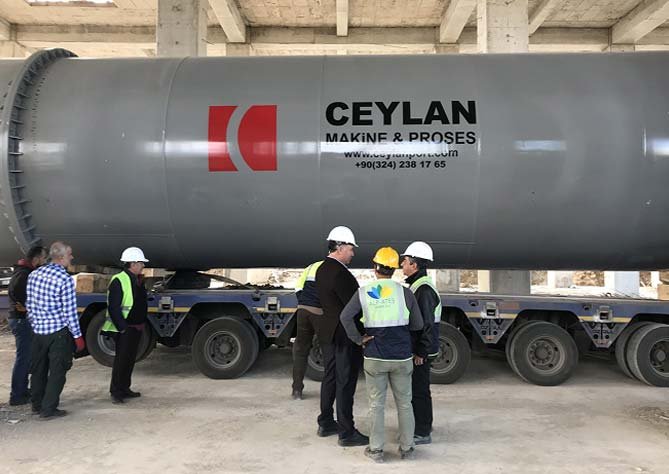
For over 20 years, Machine et Procédé Ceylan has been a reliable partner to fertilizer producers across Turkey and Europe. Here are some reasons why these manufactures trust us:
- Quality Materials: We use high-quality materials to build rotary coolers and other fertilizer manufacturing equipment that can reliably run in harsh and demanding chemical environments 24/7.
- We provide a one-year guarantee on our machinery.
- The systems we build are scaled to your tonnage goals, with performance engineered up front.
Whether you’re looking for a standalone rotary drum cooler or a fully integrated cooling system, we can engineer it to your process targets. Fill out our form to get started.
Foire aux questions
What products does the rotary cooler handle?
It runs behind NPK, urea-based, MAP and DAP granulation lines — any granular product leaving the dryer hot enough to cake or sweat in storage. The shell and ring thicknesses are specified to your grade and load, not a generic build.
What happens if feed rate or grade changes?
Grade and formula changes shift the heat load on the cooler. Counter-current airflow, inlet temperature, and fill level are set so discharge temperature holds through a changeover — small adjustments to air volume or inlet air temperature keep the outlet on target without stopping
How accessible is the cooler for inspection or cleaning?
Inspection doors are positioned for visual checks and flight/liner inspection without pulling major components. Bolt-on flight kits let flights be swapped or re-profiled during a planned stop.
Does the cooler generate a lot of dust?
Every rotation abrades granules, so some fines are unavoidable. Airflow, flight profile and fill factor are set to build enough curtain for heat transfer without grinding product into recycle — what’s generated goes to the cyclone and back to the granulator, not into the bag.