



Before you even start thinking about building an NPK line, you’ve got a question staring you in the face: do I go for a rotary drum granulator or a pan (disc) granulator? They’re both doing the same basic job – turning a powder blend into a uniform, strong granule – but they’re doing it with different mechanisms, and that makes all the difference when it comes to things like how much product you can churn out, what your product looks like, and how much you’ll need to keep maintenance coming in.
We’ve put this comparison together for the person who’s still weighing up the options and wants a straightforward rundown of the trade-offs – not a sales pitch for one technology over the other.
How Each Machine Works
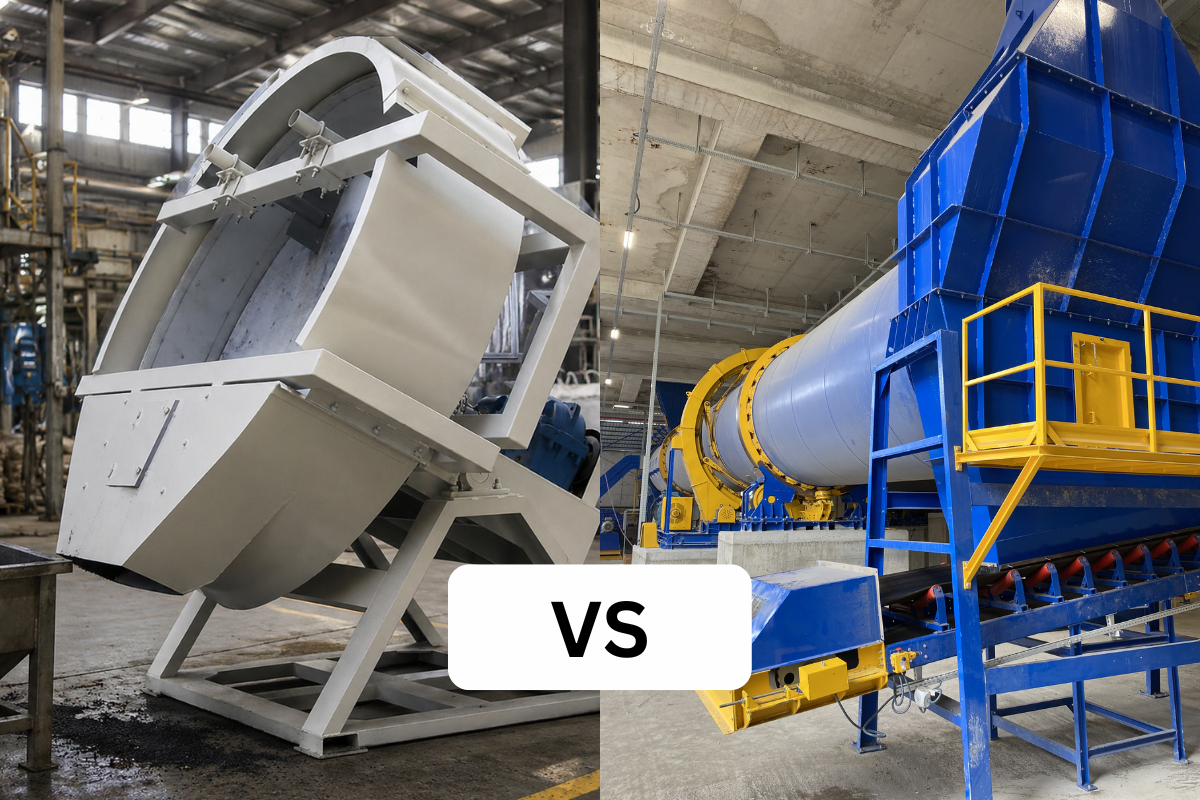
Rotary drum granulators are horizontal rotating cylinders. As the drum turns, the charge forms a rolling, tumbling bed along the bottom of the shell, and a binder or liquid addition — steam, slurry, or a pipe-reactor melt — is sprayed onto that moving bed to promote nucleation and layered granule growth. The granules grow by coalescence and by layering — fines coating onto larger particles — as the rolling bed snowballs them with each revolution. Residence time is controlled by adjusting drum speed, internal arrangement, and fill level.
Pan (disc) granulators are rotating inclined discs – typically set at an angle between 45 and 55 degrees, depending on the application and feed material. The powder feed and binding agent are added to the spinning disc, and as granules form and grow, centrifugal and gravitational forces act on the bed: larger, denser granules migrate to the rim and discharge over the edge of the pan, while smaller particles remain on the disc and continue growing. This natural classification effect means you get a reasonably sorted size distribution at the discharge – which can be useful for splitting your product into different size fractions.
The way these two machines work – one by tumbling the bed, the other by centrifugally classifying it – is the root of all the other differences.
Throughput
Rotary drums scale up easily. Residence time and bed depth can be controlled independently from granule growth rate, which means they can handle a larger feed rate without running into the same problems pan granulators do. Most large-scale operations – especially those running more than 10 t/h – use rotary drums for exactly this reason.
Pan granulators, on the other hand, are generally more suited to lower or moderate throughputs. When you’re running at smaller scale, the natural size-classification effect on the disc works well, but as you try to push it up to bigger throughputs, the disc just gets too deep and chaotic for the sorting effect to work properly.
Product Shape and Quality
Pan granulators are known for producing round, uniform granules with a fairly narrow size distribution. The rolling action on the disc encourages spherical development, and the disc’s built-in classification does the rest – on-size granules roll to the rim and discharge, while undersized stay on the disc and keep growing. The real payoff isn’t only the shape; it’s that a tighter size spread means less material comes off the screens as oversize or undersize, so your recycle ratio stays low. That’s handy when you want consistent sizing and good flow through bins and spreaders without a lot of rework.
Rotary drums produce round granules too, but with no internal classification, the size distribution comes off broader. More of what leaves the drum sits outside your target band, so drums run a higher recycle ratio – oversize is crushed and returned, undersize is returned as-is, and only the on-size fraction moves forward. That isn’t a flaw; it’s just how a drum works, and it’s part of why drums are designed as a system with their screens and crushers rather than as a standalone machine.
Granule hardness is a separate question, and it comes mostly from your formulation and drying – not from the granulator type. Both machines can turn out a hard, shipping-grade granule or a soft, friable one, depending on the binder, the liquid phase, and how the granules are dried and cooled downstream. So don’t pick a granulator expecting it to fix crush strength on its own – that’s a recipe and process matter, and it’s worth testing with your actual materials rather than assuming the machine settles it.
Operating Costs
Pan granulators usually need less power to run (compared to a rotary drum of the same capacity) – so if you’re a smaller operation, this can make a real difference to your electricity costs per tonne.
Rotary drums generally need more power to run, but when you work out the maths at bigger scales, you often find that a single large rotary drum is cheaper to run than a bunch of smaller pan units trying to meet the same output – because things like control systems, dust collection and staffing costs don’t rise as quickly as the number of machines.
Maintenance
Pan granulators have fewer moving parts to worry about, particularly inside. However, you do still need to sort out the scraper blades to keep the disc surface clean and the bearings and drives. Rotary drums need regular maintenance to their rubber liners, which take the wear from the abrasive bed, and to the drum’strunnion rollers and drive train. That’s because they carry a heavy load – literally. But with a well-built drum that’s easy, aligned riding rings and the right drive system, you can go for years before needing a major service. However, you need to have a maintenance programme set up from day one – high throughput means that you can’t just set it and forget it.
Footprint
One of the things that pan granulators have going for them is that they take up less space. That’s a big deal if you’re doing a retrofit or you’ve got a tight budget for civil works. You can fit them into a slightly smaller space than you would a rotary drum.
Rotary drums need more length on the floor to accommodate the drum, its support structure, and all the gear you need to feed and discharge the material. But, surprisingly, even though a single drum line might be large at high tonnage, it often ends up taking up less space overall than a bunch of smaller pan units. And that’s after you take into account all the duplicate feed, discharge, and dust control gear you need for each additional unit.
Which Should You Go With?
As a rough guide – and the right answer will depend on your grade complexity, formula, and site constraints:
If you’re doing under 5 tonnes per hour, changing grades often, and working with a tight space limit – then pan granulators are often the more budget-friendly choice. They’re also good for making specialty or niche NPK grades in small batches.
If you’re running 5+ tonnes per hour, 24/7 production, and need high throughput, then rotary drums tend to be the stronger choice. They tend to scale predictably and produce uniform granules in large capacities.
If you’re starting from scratch and planning to expand in the future, then rotary drums are worth considering because you can plan for future tonnage when you order the drum. Pan systems are a bit harder to scale up because each additional unit needs to be added in its entirety.
What to Ask Before Deciding
Before you make up your mind, get some real data on the granule crush strength and attrition tests. You should be looking at the actual throughput you plan on running, not just the rate the supplier showed you in their demo. Also, ask about the maintenance costs – specifically the cost and frequency of replacing rubber liners or scraper blades. These are the things that’ll determine your maintenance costs over the next 10 years even though they won’t cost anything when you view it in cost per ton of production. And make sure you model your future capacity needs – buying a granulator that can only do today’s tonnage is just setting yourself up for future replacement costs.
If you’re evaluating granulator options for your NPK production line, our team can model up your production plan, including throughput, granule quality targets, and space constraints.