



Hersteller von Düngerdosiersystemen
Präzise Dosierung mit einer Genauigkeit von 0,5 %
Our hoppers are designed with a 2 mm corrosion allowance
Mit einem natürlichen Hangwinkel von 32 bis 36°
Description
Allgemeines Wissen über Dosiersysteme
Alle Hersteller von Dosiersystemen wissen, dass in jedem kontinuierlichen Dosierprozess – ganz gleich, ob Düngemittel formuliert, Tierfutter gemischt, Reinigungsmittel zusammengesetzt oder Kathodenmischungen für Batterien hergestellt werden – industrielle Dosiertechnik wie Dosiersysteme als Garant für die Rezepturgenauigkeit fungiert.
Seine Kernaufgabe besteht darin, feste oder flüssige Inhaltsstoffe mit exakt der richtigen Rate zu dosieren, damit die nachgeschalteten Anlagen eine perfekt ausgewogene „Ernährung“ erhalten.
Die meisten Anlagen entscheiden sich bei ihren Düngerdosiersystemen für einen von zwei grundlegenden Ansätzen:
Volumetrische Dosierung
Es basiert auf einer Förderschnecke, einem Förderband oder einer Zellenradschleuse mit fester Drehzahl, deren Verdrängung pro Umdrehung bekannt ist. Dieses Verfahren ist einfach und kostengünstig, setzt jedoch voraus, dass die Schüttdichte konstant bleibt; nimmt Ihr granulierter Harnstoff plötzlich Feuchtigkeit auf, weicht der Massenstrom ab – selbst wenn der Volumenstrom unverändert bleibt.
Gravimetrische (gewichtsbasierte) Dosierung
Measures the actual mass in real time—either by weighing the hopper and subtracting (“loss-in-weight”) or by placing a belt conveyor on load cells (“weigh-belt”). The controller continuously adjusts feeder speed to keep the mass flow on setpoint, compensating for density, temperature, or particle-size changes. Because it references true weight, gravimetric dosing in fertilizer dosing systems routinely achieves accuracies of ±0.25 % to ±0.5 %, meeting OIML R61 Class 0.5 requirements for trade-legal pack-off lines.
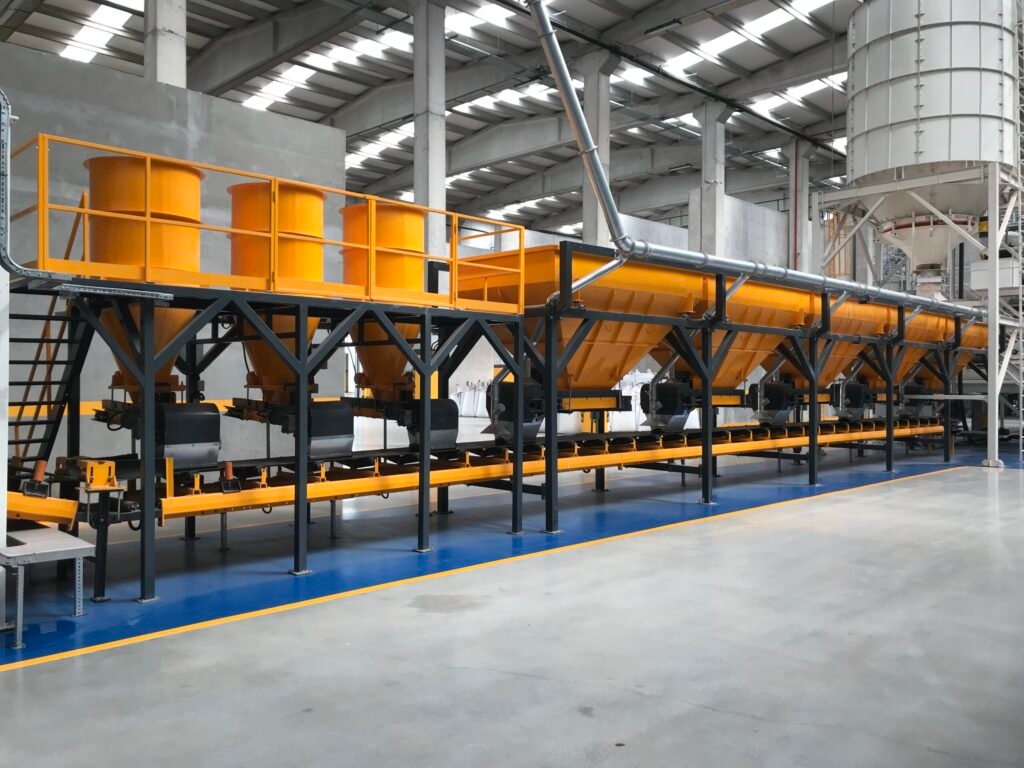
Ceylan Machine & Process builds its fertilizer dosing systems on this second principle: loss-in-weight hoppers running on load cells, with the PLC trimming feeder speed through a VFD in real time.
Hauptmerkmale und Vorteile:
Unabhängig vom Prinzip vereint ein modernes Dosierskid eines erfahrenen Herstellers von Dosiersystemen üblicherweise:
- Hoppers and feeders sized for surge volume and flow characteristics (twin screws for cohesive powders, belts for friable granules)—all fundamental sub-assemblies of fertilizer dosing equipment.
- Sensoren – Wägezellen für das Gewicht, Encoder für die Geschwindigkeit, gelegentlich Mikrowellen- oder Nahinfrarotsonden zur Feuchtigkeitskompensation.
- Steuerung – ein PID-Regelkreis, der auf einer SPS oder einem Embedded Controller läuft und über EtherNet/IP, PROFINET oder Modbus mit dem SCADA-System der Anlage vernetzt ist.
- Hygienic and safety features on the fertilizer dosing system, like 304/316L stainless steel contact surfaces, tool-free clean-out, explosion-relief panels, and aspiration ports to keep respirable dust below regulatory thresholds.
- Compliance tools such as auto-calibration routines, audit-ready data historians, and recipe management with electronic signatures for GMP or ISO 9001 traceability.
Wenn ein Dosiersystem korrekt spezifiziert und gewartet wird, leistet es weit mehr als lediglich die Produktzuführung: Es sichert die Produktqualität, reduziert Nacharbeiten und bildet das datentechnische Rückgrat für kontinuierliche Verbesserungen sowie behördliche Audits.
Intelligente Designdetails, die sich auszahlen
Aufkommende Trends, Design-Fallstricke und ROI-Kennzahlen
Die neueste Generation von Düngerdosiersystemen wird von drei zusammenlaufenden Trends geprägt.
Erstens: Digitalisierung.
In kontinuierlichen Dosiersystemen übertragen nun Ethernet-basierte Wägezellen, vibrationsunempfindliche Piezosensoren und Hochgeschwindigkeits-Edge-Controller zeitgestempelte Massenflussdaten direkt an Anlagen-Historians oder Cloud-Analyseplattformen. Bediener können Driftmuster bereits Tage im Voraus erkennen, bevor diese zur Produktion einer spezifikationswidrigen Charge führen, während Machine-Learning-Modelle die PID-Parameter dynamisch optimieren, um die Dosiergenauigkeit um weitere 0,1 % zu steigern.
Zweitens: modulares Hygienedesign
Sliding rail undercarriages, inflatable seals, and CIP (Clean-in-Place) spray balls let fertilizer dosing systems switchover from an NPK blend to an organic compost premix in under an hour without manual scraping—critical for multiproduct toll facilities.
Drittens: regulatorischer Druck.
In fertilizer and feed, ATEX/IECEx directives now require documented explosion-risk assessments; dosing hoppers larger than 1 m³ may need relief vents, grounding studs, and antistatic linings. Meanwhile, EU dust-emission limits are tightening to 3 mg m⁻³, pushing integrators toward enclosed weigh-belt systems with integrated HEPA filtration, especially in any fertilizer dosing system built for EU markets.
Several design missteps still haunt retrofit projects. In a fertilizer dosing system, undersizing hopper skirts chokes cohesive powders, mounting load cells off-axis induces hysteresis, and ignoring thermal expansion in screw shafts warps pitch—each costing far more in downtime than the upfront saving. A disciplined HAZOP review and a bulk-solids flow test can avert most of these headaches.
Specifications
Feeding Mechanism
Precision
Control System
Drive System
Protection Class
Flow Aid








Lorem ipsum dolor sit amet conse, aliquam ut enim non integer.
Lorem ipsum dolor amet consectetur, integra donum vitae metera in primitia tactu mobilis nisi. Vitae et sociosque augue ulm.
What Our Customers Say
Lorem ipsum dolor sit amet, consectetur adipiscing elit. Ut elit tellus, luctus nec ullamcorper mattis, pulvinar dapibus leo.
Lorem ipsum dolor sit amet, consectetur adipiscing elit. Ut elit tellus, luctus nec ullamcorper mattis, pulvinar dapibus leo.
Lorem ipsum dolor sit amet, consectetur adipiscing elit. Ut elit tellus, luctus nec ullamcorper mattis, pulvinar dapibus leo.