
Fertilizer Bulk Blending System Facilities
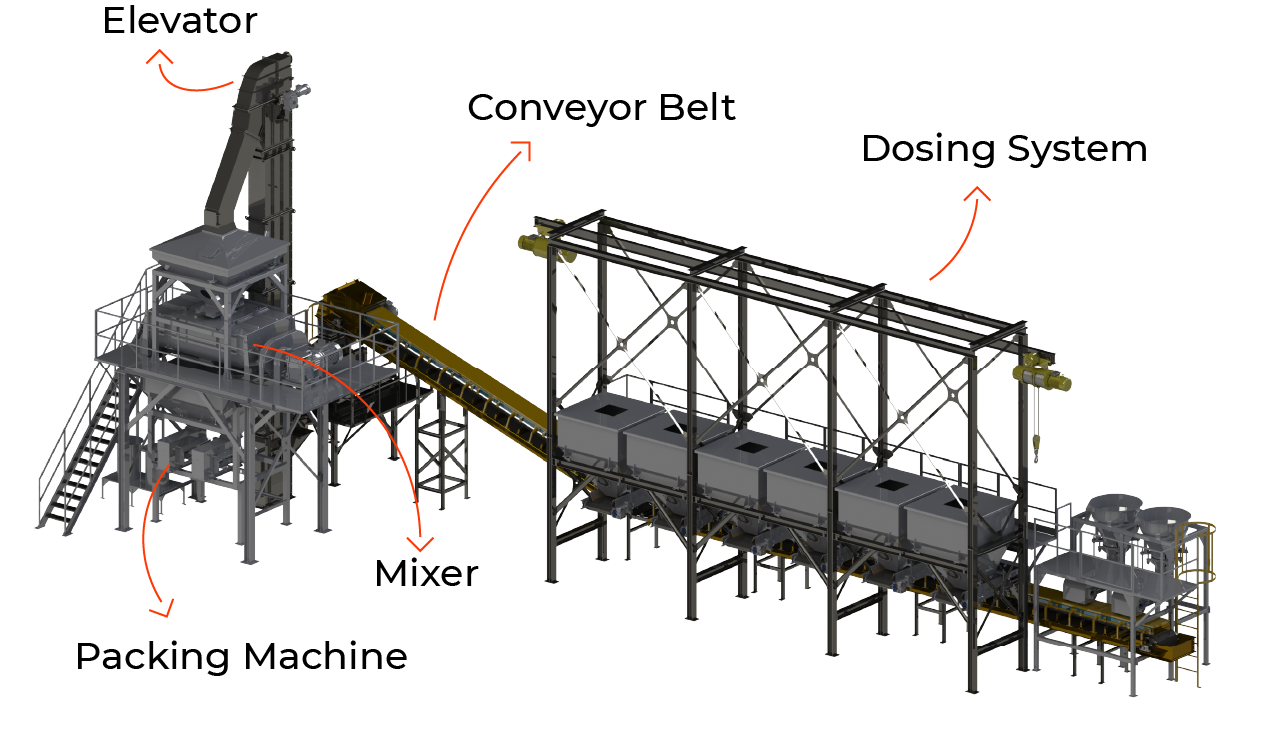
Our fertilizer blending equipment is designed to handle various raw materials and precise blending processes, guaranteeing consistent, high-quality output.
We provide an industrial blending process with end-to-end services from initial design to full-scale operation, ensuring that your production line runs efficiently and meets the demands of modern agriculture.
Step 1: Raw Material Preparation
- Raw Material Receiving (Big-Bag / Loader)
- Belt Feeding with Reduced Weighing System (“4 load cells”)
- Belt conveyors with VFD speed control
- Dust Collection at Transfer Points (clean & safe operation)
Step 2: Blending Process
- Precision Blending: In our fertilizer bulk blending system, state-of-the-art inline blending systems are designed to achieve this through a heavy-duty double shaft paddle mixer that runs a controlled 6-minute mixing cycle.
- Continuous Batch Flow: The mixer is supported by a dedicated pre-batch hopper, which allows for the preparation of the next batch while the current batch is mixing, thereby reducing downtime and stabilizing throughput in industrial blending operations.
- Quality Control: Real-time monitoring systems to maintain the integrity of the blending operation.
Step 3: Dedusting
- Efficient dust management techniques are implemented to minimize material loss, particularly in a powder NPK facility where fine particles are present. Blended products are conditioned appropriately for storage or further processing.
- The collected powder is fed back into the system.
Step 4: Packaging and Storage
- Accurate Bagging: In our fertilizer packing system, the blended product is fed to the bagging hopper first, then discharged into the packing machinery, which feeds bags via a controlled belt feeder for stable flow. The bagging scale measures weight using load cells and applies coarse/fine feeding logic (fast fill, then slow top-up) to hit the target weight consistently.
- Bag Closing & Handling: Once filled, bags move through automatic bag clamping and bag sewing (or heat sealing, depending on bag type). For smoother dispatch, the line can include a checkweigher (optional) for clean, efficient packaging at industrial throughput.
Work With Us
Designing a reliable fertilizer bulk blending system requires more than standard equipment. It demands durable materials, process accuracy, and systems sized correctly for real production targets.
At Ceylan Machine & Process, we build fertilizer blending equipment and industrial blending equipment using high-quality materials, engineered for continuous operation and consistent output.
Every project is designed around your formulation needs, throughput requirements, and site conditions. Our systems are delivered with a 1-year machinery guarantee and can be specified with guaranteed production capacity, so performance expectations are clear from the start.
From concept design to commissioning, we support the full lifecycle of your industrial blending facility. Fill out a form to get started.
Frequently Asked Questions
What is a fertilizer bulk blending system?
This system combines multiple solid raw materials into a uniform blend according to a defined formulation. These systems are commonly used for flexible fertilizer production, where multiple grades of raw materials are fed according to your formula.
Can the system be customized for specific facilities?
Yes. Fertilizer blending equipment systems are designed around site layout, available space, and desired output. Customization may include storage configuration and integration with downstream packaging or storage equipment.
How is blend accuracy controlled?
In industrial blending applications, accuracy is achieved through calibrated dosing, controlled material transfer, and properly sized blending units. This ensures each batch meets formulation requirements before packaging and storage.
Is bulk blending suitable for high-capacity fertilizer production?
Yes. A properly engineered fertilizer bulk blending system can support high throughputs when paired with suitable conveying, storage, and packaging equipment. Capacity is determined during the system design phase.