



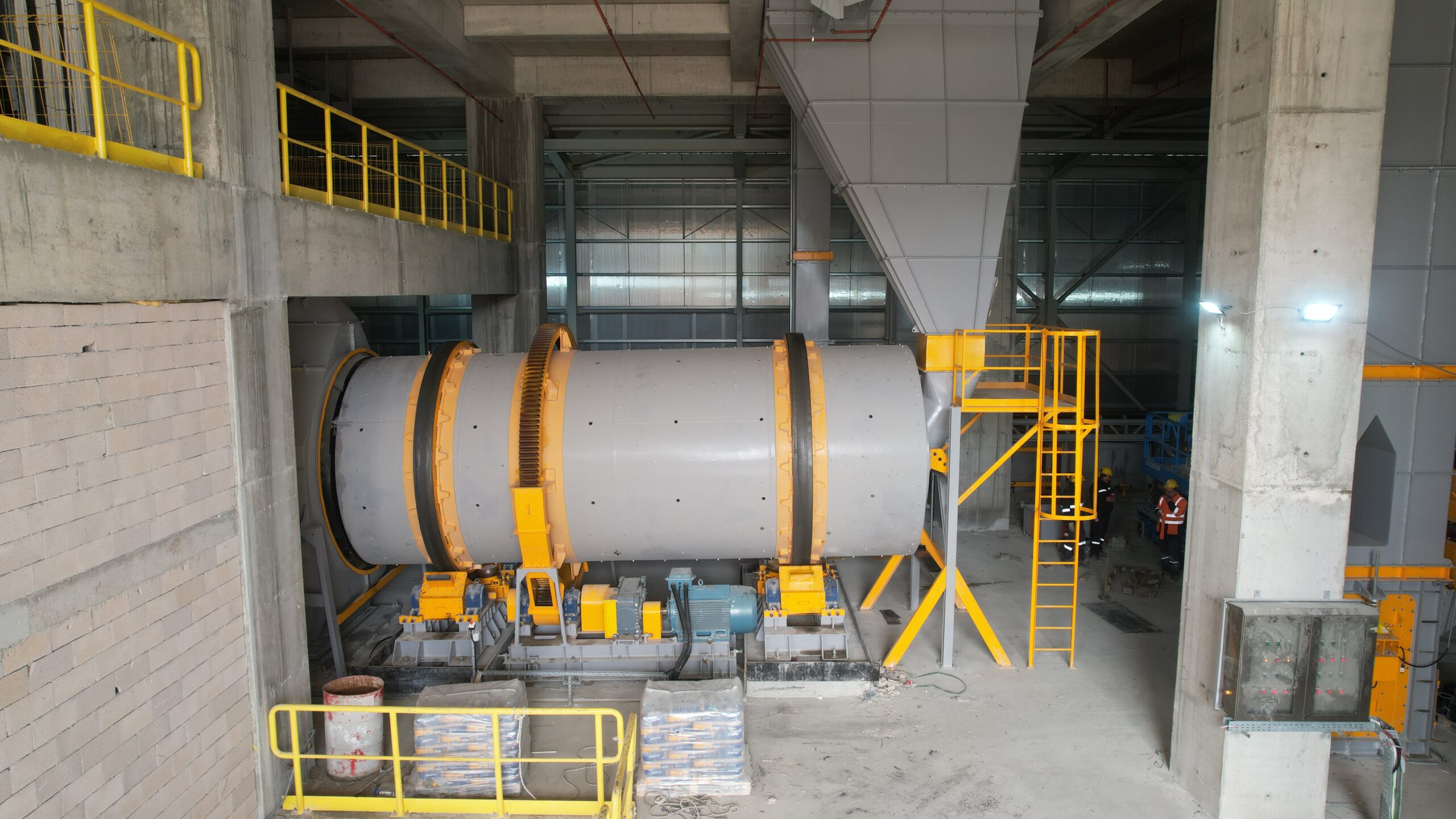
Choisir un granulateur à tambour rotatif en se basant uniquement sur les spécifications du catalogue peut s'avérer catastrophique pour tout développeur de projet. Un tambour dont la capacité nominale correspond à votre débit cible peut néanmoins être fondamentalement inadapté à votre procédé si son dimensionnement ne tient pas compte des caractéristiques de l'alimentation, du type de liant ou d'ajout liquide utilisé, du temps de séjour nécessaire dans le tambour, de la quantité de recyclage que le tambour devra traiter et du système de déchargement qui contrôle la rétention et la vitesse de sortie. Définir les spécifications correctement dès le départ élimine la cause la plus fréquente de sous-performance dans les nouvelles unités de production de NPK : une section de granulation qui ne parvient pas à se stabiliser, qui entraîne un recyclage excessif et qui devient le goulot d'étranglement permanent d'une ligne censée fonctionner de manière fluide.
Cet article expliquera les principales variables qui régissent le dimensionnement des granulateurs pour la production d'engrais NPK et comment chacune d'elles doit être abordée lors du processus de spécification.
La relation entre le débit et la géométrie du tambour
La première étape du dimensionnement d'un granulateur consiste à déterminer le débit nominal, c'est-à-dire la quantité de produit que votre installation doit fournir par heure de manière constante. Cependant, ce chiffre ne suffit pas à lui seul pour déterminer la taille du tambour. Ce dernier doit être dimensionné non seulement en fonction du débit de produit, mais aussi en fonction de la charge totale en circulation, incluant le flux de recyclage provenant de l'étape de criblage.
Dans un NPK stable système de granulation d'engrais Le taux de recyclage, soit la quantité de matière non conforme renvoyée au granulateur par rapport à la quantité de produit conforme, se situe généralement entre 2:1 et 4:1, selon la formulation et les performances de tamisage. Ainsi, une usine visant une production de 20 tonnes de produit par heure pourrait avoir besoin d'un granulateur capable de traiter entre 60 et 100 t/h de matière en circulation (40 à 80 t/h de recyclage et 20 t/h de produit). Si le dimensionnement du tambour se base uniquement sur le débit de produit, sans tenir compte du recyclage, la machine risque de fonctionner en permanence au-delà de sa capacité nominale.
Le diamètre et la longueur du tambour sont choisis en fonction du volume de rétention nécessaire pour maintenir le lit au facteur de remplissage optimal tout en obtenant le temps de séjour cible. À charge circulante totale égale, la profondeur réelle du lit et le temps de séjour sont fortement influencés par la vitesse de sortie du matériau et par la géométrie de l'extrémité de décharge, notamment par la hauteur de réglage de l'orifice de sortie, du barrage ou de l'anneau de retenue. Un tambour plus long peut être utile, mais ne garantit pas automatiquement le temps de séjour requis si la vitesse de décharge est faible ou si le matériau avance trop rapidement. Un diamètre plus important permet d'obtenir un volume de lit plus élevé avec un pourcentage de remplissage inférieur, tandis qu'un tambour plus long augmente la longueur de contact ; le compromis final doit prendre en compte la pente, la vitesse de rotation, les éléments internes, la masse volumique apparente et la configuration de la sortie.
Facteur de remplissage : le point idéal 10 – 15%
Le facteur de remplissage, ou rétention, est la fraction du volume utile du tambour occupée par le lit de brassage en régime permanent. C'est l'un des paramètres les plus importants à régler correctement. granulation en tambour. La pratique industrielle pour les granulateurs à tambour NPK situe cette valeur entre 10 et 15% de la section transversale du tambour, mais elle ne doit pas être considérée comme universelle ; certains fournisseurs de procédés suggèrent 15-20%, et la valeur acceptable dépend de la formule, de la distribution granulométrique des particules recyclées, de l'ajout de liquide et de la vitesse axiale du matériau.
Un fonctionnement en dessous de la limite inférieure donnera un lit mince et mal consolidé. Le matériau risque de passer trop rapidement, la répartition du liant et de l'humidité devient inégale, et le produit final est moins homogène en termes de granulométrie. L'étape de criblage doit alors rejeter une quantité supplémentaire de matériau, ce qui augmente la charge de recyclage.
En revanche, si le niveau de remplissage dépasse la plage validée, le lit devient trop épais, les forces d'interaction entre les particules augmentent et le mécanisme de granulation passe d'une croissance stratifiée contrôlée à une agglomération incontrôlée, surtout en cas d'ajout de liquide ou d'humidité élevée de l'alimentation. On observe alors la formation de grumeaux humides, une augmentation considérable de la production de particules surdimensionnées et une saturation du broyeur à marteaux et des tamis.
Pour maintenir un facteur de remplissage optimal, il est indispensable d'adapter le diamètre et la longueur du tambour au volume total en circulation et à sa capacité de rétention, et de contrôler précisément le débit d'alimentation. Un système de dosage gravimétrique d'une précision de 0,51 TP3T est essentiel pour garantir la stabilité du facteur de remplissage.
Temps de contact : 8 à 10 minutes est optimal pour la plupart des préparations.
Le temps de séjour correspond à la durée pendant laquelle le produit reste à l'intérieur du tambour avant d'être déchargé ; c'est le facteur clé qui régit la granulation. Pour les produits NPK dans un granulateur à tambour rotatif, le temps de séjour nominal est généralement compris entre 8 et 10 minutes, selon la formulation. Le temps de séjour cible doit permettre :
- Les fines particules humides et les particules de semences recyclées se fixent aux granulés existants.
- Des granules se forment par superposition contrôlée au fur et à mesure de la distribution du liant ou du liquide.
- Action mécanique suffisante pour consolider et arrondir les particules
Le temps de séjour est déterminé par plusieurs facteurs interdépendants : la longueur du tambour, son inclinaison, la vitesse de rotation, la charge circulante totale et la géométrie de l'orifice de décharge. Pour une géométrie de tambour donnée, une inclinaison plus importante accélère le transit du matériau et réduit le temps de séjour, tandis qu'une inclinaison plus faible l'allonge. La vitesse de rotation influe sur la portance des aubes internes et la hauteur de chute, deux éléments qui déterminent la rapidité avec laquelle le matériau atteint l'orifice de décharge. L'orifice de décharge, le barrage ou l'anneau de retenue est particulièrement important car il définit le niveau du lit que le matériau doit atteindre avant de sortir.
En pratique, l'inclinaison du tambour est généralement fixée lors de l'installation, à environ 2,4%. La vitesse de rotation, quant à elle, permet d'ajuster précisément le temps de séjour en fonction des variations de l'alimentation. C'est pourquoi les granulateurs à variateur de fréquence sont la norme dans les lignes NPK bien conçues : la possibilité d'ajuster la vitesse sans interrompre la production est essentielle pour maintenir un temps de séjour stable malgré les variations d'humidité de l'alimentation, les changements de formulation et les variations saisonnières de température ambiante. Un temps de séjour trop court empêche la granulation complète et entraîne l'accumulation de fines derrière le tamis. À l'inverse, un temps de séjour trop long, surtout avec un mélange très humide, risque de provoquer une absorption excessive d'humidité par les granulés, formant des grumeaux qui peuvent obstruer tout le système et perturber le cycle de recyclage.
Pente du tambour – Et son lien, pas si secret, avec d'autres variables
On a souvent tendance à négliger l'inclinaison du tambour, mais elle a pourtant un impact considérable en pratique. Une inclinaison trop prononcée (supérieure à 4-5%) va propulser le matériau à travers le tambour et réduire le temps de séjour effectif, même en diminuant la vitesse pour compenser. De plus, elle réduit la profondeur du lit par rapport au diamètre du tambour, ce qui limite le facteur de remplissage et le rend moins performant.
À l'inverse, si la profondeur de remplissage est insuffisante (inférieure à 2%), le transport des matériaux peut devenir lent. Les matériaux risquent de s'accumuler à l'entrée et de rendre le système extrêmement sensible à la moindre variation du débit d'alimentation : une brève augmentation de ce débit entraînera un approfondissement soudain du lit, poussant le facteur de remplissage à sa limite supérieure et provoquant la formation de nouveaux agglomérats.
Trouver la pente adéquate pour une configuration donnée consiste à trouver le juste équilibre entre des paramètres tels que la taille du tambour, la masse volumique apparente du matériau à alimenter, la hauteur de l'orifice de sortie ou du barrage, et la quantité de produit que l'on souhaite extraire. En général, la norme industrielle se situe autour de 3-4%.
Tri des caractéristiques de l'alimentation
Avant même de penser à optimiser la géométrie du tambour, il est essentiel de comprendre les paramètres en jeu : la masse volumique apparente, la teneur en humidité, la granulométrie des matières premières et la propension du mélange à absorber l’humidité. Tous ces facteurs déterminent en grande partie :
- Le débit de matière entrant dans le tambour pour une masse de sortie donnée
- La quantité de liant, de vapeur et d'eau à ajouter pour obtenir une croissance contrôlée des granules sans mouiller le lit.
- Probabilité que le matériau colle ensemble à des niveaux d'humidité plus élevés
- Et le taux auquel vous allez accumuler un grand nombre d'amendes, ce qui influe sur l'estimation du taux de recyclage.
Les solutions NPK hygroscopiques, par exemple celles à forte teneur en nitrate d'ammonium ou en urée, nécessitent un contrôle plus strict de l'humidité et de l'ajout de liquide, ainsi qu'une marge de fonctionnement plus importante. Augmenter la plage de remplissage n'est pas toujours la solution ; de faibles variations dans la quantité de liant peuvent entraîner une agglomération de la couche, d'une stratification contrôlée à une agglomération. Par conséquent, les spécifications du fût doivent préciser la méthode de contrôle, les modalités de recyclage et le système de vidange.
Que se passe-t-il lorsque vous vous trompez de taille ?
Si vous spécifiez un tambour trop petit, vous obtiendrez systématiquement le même résultat : un cycle produisant un excès de recyclage. Le tambour est trop petit pour traiter la quantité adéquate de matériaux au débit de sortie requis. Vous avez donc le choix : soit réduire le débit d'alimentation et limiter la production, soit accepter que le tambour se remplisse beaucoup trop, ce qui provoque la formation d'agglomérats indésirables et génère davantage de matériaux surdimensionnés.
Et puis, la situation empire : les matériaux trop volumineux sont écrasés et renvoyés dans le tambour, ce qui entraîne une surproduction et aggrave le problème du taux de remplissage. C'est un cercle vicieux, et tenter de le corriger sans réduire la production ou remplacer le tambour est quasiment impossible.
Résumé : Liste de contrôle de dimensionnement pour les développeurs de projets
Lors de l'évaluation des spécifications d'un granulateur pour une installation NPK, vous devez confirmer les paramètres suivants avant même de penser à acheter l'équipement :
- Production totale de matériaux: c'est le rendement du produit plus le niveau de recyclage prévu au taux de recyclage nominal (2:1 à 4:1)
- facteur de remplissage: vérifier que la valeur se situe dans la plage de conception validée (10-15%) pour la charge circulante totale, en tenant compte de la hauteur de l'orifice de sortie, du barrage ou de l'anneau de retenue utilisé pour définir la profondeur du lit.
- Temps de séjour: 8 à 10 minutes à la pente de tambour nominale et à la vitesse de fonctionnement
- variateur de fréquenceVérifiez que le tambour est équipé d'un variateur de vitesse permettant de régler la vitesse en cours de fonctionnement.
- Caractéristiques de l'alimentation: Déterminez la masse volumique apparente, la teneur en humidité et l'hygroscopicité de tous les composants de la formule, et transmettez ces informations au fabricant de l'équipement.
- marge de recyclageSpécifiez le tambour pour qu'il puisse gérer des taux de recyclage jusqu'à 5:1, afin de vous laisser une certaine marge de manœuvre lors des démarrages et des transitions de qualité.
Si vous spécifiez un granulateur en fonction de ces paramètres, plutôt que de simplement sa capacité finale, il entrera en service avec la plage de fonctionnement adéquate pour fonctionner de manière stable dès le premier jour.
Ceylan Machine & Process conçoit et fabrique des granulateurs à tambour rotatif pour les lignes de production d'engrais NPK, DAP et MAP. Pour toute question technique ou pour discuter d'un projet spécifique, Contactez notre équipe d'ingénieurs.