The Rundown
- The two granulation methods solve the same problem but behave nothing alike once you start running material through them.
- Dry lines stick to pressure only, which keeps the setup light and eliminates several steps.
- Wet lines add binders and a dryer, and while it’s extra work, the granules usually come out tougher and more uniform.
- Most plants choose based on whatever gives them fewer headaches: how the powder reacts, how much room they’ve got, and what the final product actually needs to look like.
Fertilizer production is at the core of modern agriculture, ensuring that crops receive the nutrients they need to grow strong, healthy, and productive.
One of the most critical steps in manufacturing fertilizers is granulation, the process of turning raw materials into solid, uniform granules that are easy to transport, apply, and store. Two primary techniques dominate the industry: dry granulation vs. wet granulation.
While both methods achieve the same ultimate goal, their processes, advantages, and applications differ significantly. Understanding these differences is crucial for producers seeking to select the most suitable method for their plant’s efficiency and profitability.
Understanding Granulation in Fertilizer Production
Granulation is the process of binding fine raw particles into larger, more uniform granules. Fertilizer in powdered form is difficult to handle, prone to dusting, and can create uneven distribution when applied to fields.
Granulation addresses these challenges by producing compact particles with enhanced flow properties, controlled nutrient release, and improved product strength. Dry vs. wet granulation depends largely on material properties, production capacity, and operational goals.
What Is Dry Granulation?
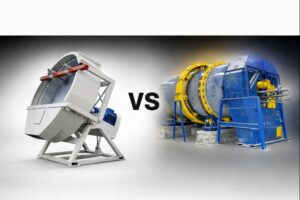
Dry granulation is a process that compacts raw fertilizer powders without the use of liquids or heat.
Instead, mechanical pressure is applied to densify the material and press it into larger pieces, which are then milled and screened into uniform granules.
This method is often carried out using a roller compactor or a slugging press. The absence of liquid binders makes dry granulation suitable for heat- and moisture-sensitive materials.
What Is Wet Granulation?
In comparing dry granulation vs. wet granulation technologies, the latter, in contrast, uses liquid solutions or binders to agglomerate fine powders into granules.
The binder liquid acts as a glue, binding particles together before being dried in a rotary dryer or fluidized bed. This process produces strong, durable granules with excellent uniformity, significantly reducing dusting.
Wet granulation requires additional equipment, such as mixers, granulation drums, and dryers, making it a more complex process but also highly effective for large-scale fertilizer production.
The Role of Raw Material Properties
One of the most important considerations in choosing between dry granulation and wet granulation is the nature of the raw materials.
Dry granulation is more effective for materials that already have some cohesive properties and can bind under pressure without the need for additives. On the other hand, wet granulation is preferred for powders that are light, fluffy, and resistant to compaction.
The liquid binders in wet granulation enhance adhesion, ensuring the creation of uniform, robust granules even with challenging raw materials.
Production Costs and Energy Consumption
The economics of fertilizer granulation play a major role in production decisions. When comparing dry granulation vs. wet granulation, dry granulation tends to be more cost-efficient because it eliminates the need for liquid binders and drying equipment.
The absence of a drying stage also reduces energy consumption and shortens processing time. In contrast, wet granulation requires significant investment in dryers and consumes more energy to remove moisture from the final product.
However, higher durability and better granule quality often justify the added costs, particularly for large-scale fertilizer plants.
Granule Strength and Durability
Fertilizer granules must be strong enough to withstand storage, packaging, and handling without breaking down into dust. Between dry granulation vs. wet granulation, wet granulation typically produces harder, more abrasion-resistant granules because the liquid binder creates strong internal bonds.
These granules are less likely to fracture during transport and application. While dry granulation produces satisfactory granule strength, the absence of liquid binders can sometimes result in weaker structures, especially if the raw material lacks natural binding properties.
Environmental Considerations
Environmental impact is another factor that we consider when comparing dry granulation vs. wet granulation technologies. Dry granulation eliminates the use of solvents, binders, or additional chemicals, resulting in a cleaner and more environmentally friendly process.
It also produces less wastewater since no drying or liquid handling is required. Wet granulation, while effective, generates additional emissions and wastewater during the drying stage, requiring more advanced environmental control systems to meet regulatory standards.
Scalability and Industrial Applications
Both methods can be scaled for industrial fertilizer production, but they cater to different needs. Dry granulation is ideal for small to medium-sized operations that require cost-effective production with minimal equipment.
It is also preferred when working with sensitive materials that cannot tolerate moisture or high heat. Between dry granulation vs. wet granulation, wet granulation, on the other hand, is widely used in large-scale fertilizer plants where high production volumes and premium granule quality are essential.
It is the method of choice for producing NPK fertilizers and other complex blends that require precise granule uniformity.
Process Flexibility
One of the strengths of wet granulation is its flexibility. Producers can modify binder types, concentrations, and process conditions to tailor granule properties such as porosity, hardness, and nutrient release rates.
This flexibility enables granular fertilizer manufacturers to design fertilizers tailored to specific crops, soil conditions, or regional requirements.
Dry granulation offers limited customization, as the process primarily relies on mechanical compaction. When thinking about dry granulation vs. wet granulation technologies, it’s important to remember that while dry granulation can be effective for certain formulations, it lacks the adaptability of wet granulation in creating specialized fertilizer products.
Comparing Final Product Quality
When it comes to final product quality, wet granulation often takes the lead. Its granules are highly uniform in size, stronger, and more resistant to dusting.
Farmers benefit from even spreading across fields and consistent nutrient delivery. Dry granulation produces acceptable results; however, variations in particle strength and size distribution may occur, particularly when working with challenging raw materials.
Nonetheless, for applications where simplicity and cost control outweigh cosmetic or structural perfection, dry granulation remains a reliable choice.
Future Trends in Fertilizer Granulation
The fertilizer industry continues to evolve with advancements in technology. Automation, real-time monitoring, and precision machinery are enhancing both dry and wet granulation processes.
The increasing demand for sustainable and environmentally friendly practices is prompting producers to enhance energy efficiency and reduce emissions. Hybrid approaches that combine elements of both methods may also emerge, offering the best of both worlds: the cost-efficiency of dry granulation and the durability of wet granulation.
Beyond the dry granulation vs. wet granulation discussion, both are essential techniques that shape the future of modern fertilizer production. The choice between them ultimately depends on the type of raw materials, the production scale, and the desired quality of the final product.
While dry granulation offers cost savings, energy efficiency, and suitability for heat- and moisture-sensitive materials, wet granulation provides superior granule strength, durability, and uniformity, making it ideal for large-scale fertilizer plants. By carefully considering these factors, producers can select the method that maximizes efficiency and output.
At Ceylan Machinery, we are committed to providing advanced fertilizer production solutions that help businesses optimize granulation processes and deliver consistent, high-quality results for the agricultural industry. Whether you’re still debating dry granulation vs. wet granulation technologies or you know what you need and are looking for reliable manufacturers, fill out our form to get started.
Frequently Asked Questions
What’s the hidden cost of wet granulation?
It isn’t just the electricity for the dryer; it’s the scrubber system. Because you’re evaporating liquids that have been in contact with chemicals, your air exhaust has to be treated to meet environmental codes. That means a higher maintenance on fans, filters, and wastewater treatment that you simply don’t deal with on a dry compaction line.
What’s the actual footprint difference in a plant layout?
Between dry granulation and wet granulation for those with tight floor space, dry granulation wins every time. You’re essentially looking at a vertical stack: a feeder, the roller compactor, and a mill. Because you don’t need a massive rotary dryer or the 50-plus feet of ducting that goes with it, you can fit a dry line into a much smaller warehouse. Wet granulation lines are long because the material needs residence time in the heat to set properly.
Are hybrid granulation systems actually being used today?
They are starting to appear. Some plants compact materials first and then lightly agglomerate them with minimal binder to improve strength without committing to a full drying line. It’s an emerging middle-ground approach for producers who want better granules without major capital spend.