Co‑Current vs Counter‑Current Rotary Dryers: How to Choose Based on Product Temperature
Rotary dryers look deceptively simple—a rotating drum, hot gas, wet solids in, dry solids out. But one design choice quietly determines whether your product comes out safely within spec (or scorched, discolored, fused, decomposed, or even at risk of ignition): airflow direction.
In direct-contact rotary dryers, you typically have two options:
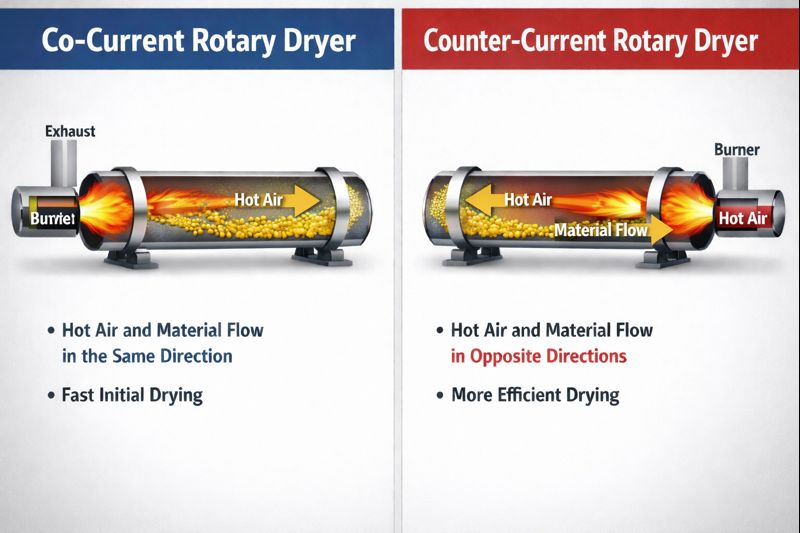
Co-current (parallel flow): hot gas and wet solids enter the same end and travel in the same direction.
Counter-current: hot gas enters from the discharge end while wet solids enter from the feed end, so the two streams move in opposite directions.
These configurations create very different solids temperature profiles along the drum—and that’s why “product temperature” is often the deciding factor, even before energy efficiency, capacity, or footprint.
Why product temperature is the right lens
Most drying problems aren’t just “remove X% moisture.” They’re “remove X% moisture without exceeding a product temperature limit” (or conversely, “remove moisture and heat the product to a target temperature for the next step”).
Product temperature matters because it drives:
Quality: color, flavor/aroma, crystal structure, hydration state, polymorph, active ingredient potency, etc.
Yield and handling: melting/softening, sticking, caking, dusting, attrition.
Safety: ignition risk, exothermic reactions, decomposition, VOC release.
Downstream compatibility: bagging limits, conveyor or storage temperature limits, coating or granulation requirements.
A key reality in direct-contact drying is that the wettest solids are naturally protected from overheating early in the process because evaporation absorbs a lot of heat. Once the solids become relatively dry, that protection fades—so where the driest solids meet the hottest gas is the crux of the choice.
How airflow direction changes the solids temperature profile
Co-current (parallel flow): hottest gas meets wettest solids
In co-current drying, the wettest material immediately contacts the hottest gas, which tends to “flash off” surface moisture quickly. This also cools the gas rapidly early in the drum, so gas and solids temperatures are typically lower toward the discharge end.
A classic explanation from the Handbook of Industrial Drying notes that co-current flow is used for heat‑sensitive materials even with high inlet gas temperatures, because the gas cools rapidly during initial evaporation at the wet end.
Temperature implication: co-current makes it easier to keep the product from exceeding a maximum temperature—especially near discharge—because the hottest gas is “spent” early and the solids trend into cooler conditions as they dry.
Counter-current: hottest gas meets driest solids
In counter-current drying, wet solids meet the coolest gas at the feed end, and as solids move forward they encounter progressively hotter gas—including the hottest gas near discharge, when the solids are at their most dehydrated state.
That’s why counter-current is often used when you need high outlet solids temperature or when moisture is strongly bound and benefits from sustained heating.
Temperature implication: counter-current increases the chance that already-dry solids will heat up significantly near discharge—good if you want hot product, risky if you must avoid overheating.