
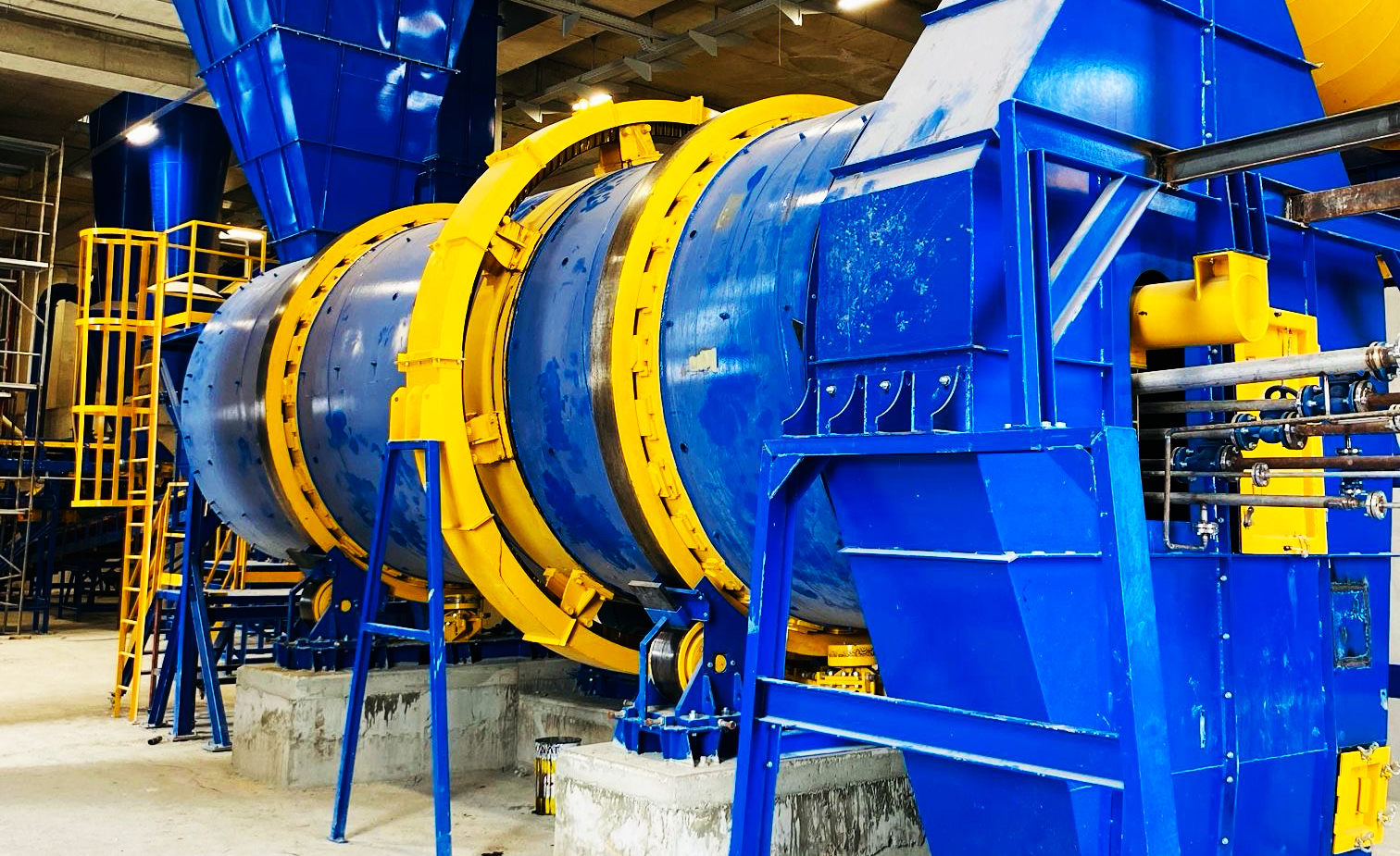
GRANULATION DRUM
Our industrial granulation drum is a heavy‑duty rotary drum fertilizer granulator that transforms fine powders—fertilizer, minerals, or chemicals—into uniform, high‑strength granules by tumbling them with precisely metered steam, molten urea, or polymeric binders under controlled temperature (50 °C–175 °C) and airflow.
Heavy-Duty Design
Our industrial granulator is engineered to withstand the abrasive conditions of chemical plants.
Uniform Granule Size
Tight size distribution means fewer fines, better downstream for inclined sieve, and a low recycle ratio.
High‑Throughput, Continuous Operation
In industrial fertilizer, mineral or chemical plants, every minute of downtime costs money. Our granulation drums are engineered for 24/7 duty by anti-sticking interior lining.
Engineered for Stable Granulation and Low Downtime
Whether you are formulating complex NPK fertilizers, specialty minerals, or chemical powders, your granulation line lives or dies by the performance of its granulation drum.
Capacity must be high, granule size must be tight, your shell and inner linings must withstand hot, abrasive slurries around the clock—often in corrosive plant atmospheres.
Drawing on years of process know‑how and the hard data in our latest specification sheet, our rotary drum fertilizer granulators deliver a rare combination of industrial‑scale throughput, fast & precise granule formation, and rugged construction that minimizes the lifetime cost of ownership.
Key Features and Benefits:
- Built to Survive Heat, Corrosion & Abrasion:
A forged‑steel riding ring carries a 15 mm‑thick carbon‑steel shell lined with overlapping EPDM rubber sheets; this composite approach absorbs impact, resists chemical attack, and prevents the product from wedging behind the liner. The granulation drum easily handles 50 – 175 °C process temperatures and abrasive duty cycles measured in decades rather than years. Automatic grease‑spray lubrication keeps the gear mesh healthy with virtually zero manual intervention. - Uniform Granule Size in Minutes:
Internal EPDM‑rubber lifter plates, a 3% drum slope, and a controlled 10–15% filling factor keep material in the bed for just 8–10 minutes—yet still yield up to 70–80% of granules in the target band. The result is fewer fines, better drying efficiency, and a premium‑looking product that commands a higher market price. - Industrial‑Scale Throughput—24 / 7 Duty:
Our granulation drums are sized for your design capacities, driven by a heavy-duty spur-tooth ring and pinion gear set, and supported on double-row trunnion rollers. Continuous 24‑hour duty means fewer change‑overs and more product out the gate every shift. An auxiliary emergency motor allows slow rotation during maintenance so the shell never bows under thermal load. - Sustainability in Focus:
The advanced rotary drum fertilizer granulator design minimizes dust generation and waste, contributing to a cleaner, more eco-friendly production process that aligns with modern environmental standards.
Smart Design Details That Pay Off
- Top & Side Inspection Doors – quick visual checks or manual clean‑outs without disassembling the feed or discharge chutes of the granulation drum; swing‑bolt closures let one technician break‑in, reseal, and restart in minutes—no crane required.
- Steep‑Angle Inlet & Outlet Chutes (60–65 °) – mirror‑polished liners and self‑draining geometry virtually eliminate caking, so even tacky slurries slide through without manual poking or purge air.
- Dedicated Air & Vapor Handling Ports – pre‑drilled, gasketed manifolds simplify “plug‑and‑play” tie‑in to scrubbers or condensers, keeping dust and NH₃ capture within tightening emission caps.
- Modular Internal Kits – bolt‑on lifters, spirals, or lump‑kickers can be swapped in a single shift; the standardized hole pattern means upgrades cost hundreds, not thousands.
- Intelligent Condition‑Monitoring Ready – the granulation drum’s vibration and temperature pad mounts are pre‑installed, so adding IIoT sensors for predictive maintenance is as easy as threading in an M16 stud.
For a concise, third‑party overview of rotary‑drum granulation principles, you may find the IPCO Drum Granulation Systems page useful.
Why Choose Our Drums?
High throughput keeps unit operating cost down; precise granulation lowers recycle streams and boosts downstream efficiency of the dryer drum; and the over‑built shell, liners, and drive components slash unplanned downtime.
Add in user‑friendly maintenance points and automated lubrication, and you get a rotary drum fertilizer granulator that frees your operators to focus on optimization instead of firefighting. In short, our granulation drums turn raw feed into saleable, uniform granules faster and more reliably.
Frequently Asked Questions
What products is this granulation drum normally used for?
Most granulation drum installations run NPK, urea-based blends, MAP, or DAP, but the drum itself is not limited to fertilizers. Mineral fines and certain chemical powders are also processed this way. As long as the feed can agglomerate when moisture or binder is introduced, the drum can usually be adapted to it.
What happens if feed quality changes?
Feed variation is normal in fertilizer plants. Changes in moisture, particle size, or chemistry usually show up first as changes in granule growth. In most cases, small adjustments to binder rate or drum speed are enough to bring the process back into balance without stopping production.
How accessible is the granulation drum for inspection or cleaning?
We position the inspection doors in a place that allows visual checks and manual clean-outs without removing major components. This makes it easier to inspect liners or lifters during planned stops and reduces the temptation to defer maintenance.
Does drum granulation create a lot of dust?
Compared to some alternative methods, dust levels are generally lower. Material stays contained inside the drum, and off-spec product can be returned directly to the process. This simplifies dust control and helps plants stay within emission limits.