
Fertilizer Dosing System Manufacturer
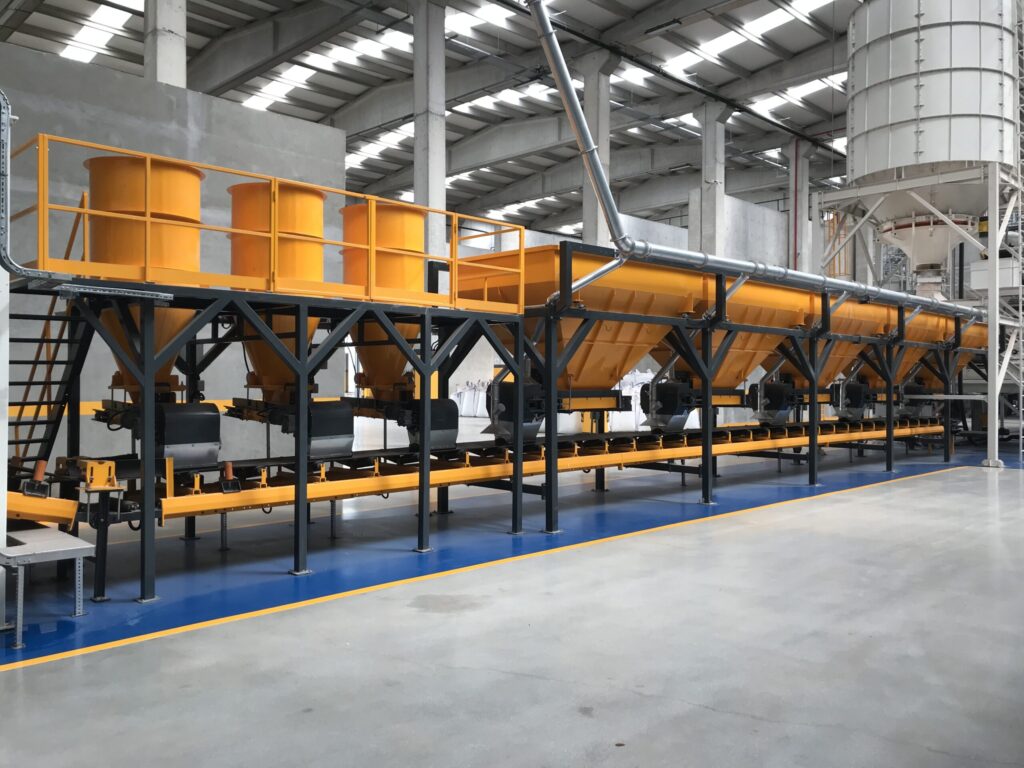
Advanced load cell technology ensuring exact measurements and consistent results for fertilizer dosing systems.
High-Precision Feeding
Precise dosing with an accuracy of 0.5%
Robust Corrosion Allowance
Our hoppers are designed with a 3 mm corrosion allowance
Efficient material flow
Featuring a 32-36° natural slope angle
General Knowledge about Dosing Systems
All dosing system manufacturers know that in any continuous-flow dosing system—whether you are formulating fertilizers, blending animal feed, compounding detergents, or making battery cathode mixes—industrial dispensing equipment like dosing systems act as the gatekeeper of recipe accuracy.
Its core job is to meter solid or liquid ingredients at precisely the right rate so the downstream equipment sees a perfectly balanced “diet.”
Most plants choose between two fundamental approaches for their fertilizer dosing systems:
Volumetric dosing
Relies on a fixed-speed screw, belt, or rotary valve whose displacement per revolution is known. It is simple and inexpensive but assumes bulk density stays constant; if your prilled urea suddenly absorbs moisture, the mass flow will drift even though the volumetric flow is identical.
Gravimetric (weight-based) dosing
Measures the actual mass in real time—either by weighing the hopper and subtracting (“loss-in-weight”) or by placing a belt conveyor on load cells (“weigh-belt”). The controller continuously adjusts feeder speed to keep the mass flow on setpoint, compensating for density, temperature, or particle-size changes. Because it references true weight, gravimetric dosing in fertilizer dosing systems routinely achieves accuracies of ±0.25 % to ±0.5 %, meeting OIML R61 Class 0.5 requirements for trade-legal pack-off lines.
Regardless of the principle, a modern dosing skid from an experienced dosing system manufacturer usually combines:
- Hoppers and feeders sized for surge volume and flow characteristics (twin screws for cohesive powders, belts for friable granules)—all fundamental sub-assemblies of fertilizer dosing equipment.
- Sensors—load cells for weight, encoders for speed, sometimes microwave or near-infrared probes for moisture compensation.
- Controls—a PID loop running in a PLC or embedded controller, networked over EtherNet/IP, PROFINET, or Modbus to the plant SCADA.
- Hygienic and safety features on the fertilizer dosing system, like 304/316L stainless steel contact surfaces, tool-free clean-out, explosion-relief panels, and aspiration ports to keep respirable dust below regulatory thresholds.
- Compliance tools such as auto-calibration routines, audit-ready data historians, and recipe management with electronic signatures for GMP or ISO 9001 traceability.
When specified and maintained correctly, a dosing system does far more than feed product; it safeguards product quality, reduces rework, and provides the data backbone for continuous improvement and regulatory audits.
Emerging Trends, Design Pitfalls, and ROI Metrics
The newest generation of fertilizer dosing systems is being shaped by three converging trends.
First, digitalization:
Within a continuous flow dosing system, Ethernet-based load cells, vibration-immune piezo sensors, and high-speed edge controllers now stream time-stamped mass-flow data directly to plant historians or cloud analytics platforms. Operators can spot drift patterns days before they trigger an off-spec batch, while machine-learning models fine-tune PID gains on the fly to squeeze another 0.1 % out of accuracy.
Second, modular hygienic design:
Sliding rail undercarriages, inflatable seals, and CIP (Clean-in-Place) spray balls let fertilizer dosing systems switchover from an NPK blend to an organic compost premix in under an hour without manual scraping—critical for multiproduct toll facilities.
Third, regulatory pressure:
In fertilizer and feed, ATEX/IECEx directives now require documented explosion-risk assessments; dosing hoppers larger than 1 m³ may need relief vents, grounding studs, and antistatic linings. Meanwhile, EU dust-emission limits are tightening to 3 mg m⁻³, pushing integrators toward enclosed weigh-belt systems with integrated HEPA filtration, especially in any fertilizer dosing system built for EU markets.
Several design missteps still haunt retrofit projects. In a fertilizer dosing system, undersizing hopper skirts chokes cohesive powders, mounting load cells off-axis induces hysteresis, and ignoring thermal expansion in screw shafts warps pitch—each costing far more in downtime than the upfront saving. A disciplined HAZOP review and a bulk-solids flow test can avert most of these headaches.
Higher Output, Higher ROI
Finally, a well-specified gravimetric skid from a dosing system manufacturer like Ceylan Machine & Process pays for itself quickly. In a continuous floor dosing system, plants that replace manual bag tipping with automated dosing typically report 1–3 % formulation yield gains, 50–70 % labor savings, and eight-to-twelve-month payback periods—especially when real-time mass data feeds an ERP system that optimizes procurement and inventory.
Frequently Asked Questions
What does a fertilizer dosing system do?
It controls how much material enters the process and when. In fertilizer production, if the feed rate drifts, problems usually show up later in granulation or screening. That’s why dosing is treated as a control function, not just a feeder.
Does dosing accuracy really affect final fertilizer quality?
Yes, although the effect is not always immediate. Small dosing errors tend to accumulate. Over time, this can lead to uneven nutrient distribution or unstable granules. Plants often trace quality complaints back to upstream dosing issues rather than downstream equipment.
What should buyers look for in a dosing system manufacturer?
Accuracy figures alone are not enough. Buyers usually look at hopper design, corrosion allowance, calibration method, and how the system integrates with existing controls. A dosing system manufacturer should be able to explain why a certain feeder or hopper geometry was selected.