



How a Rotary Drum Dryer Works
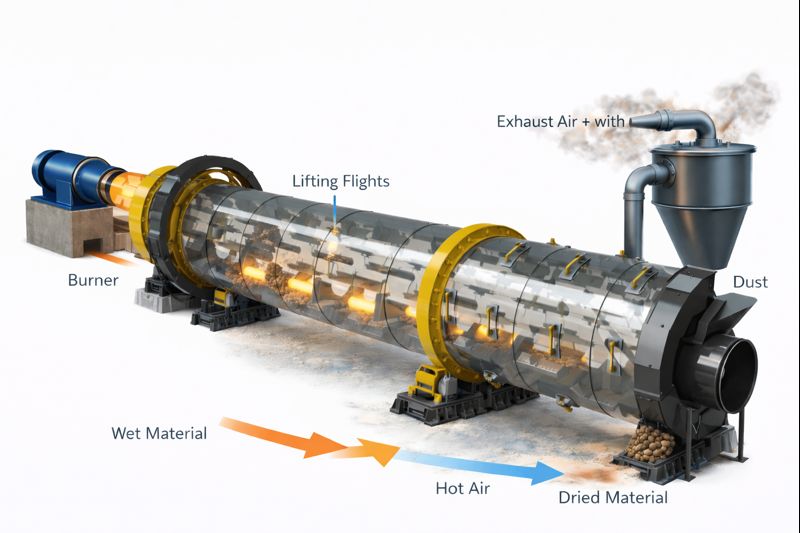
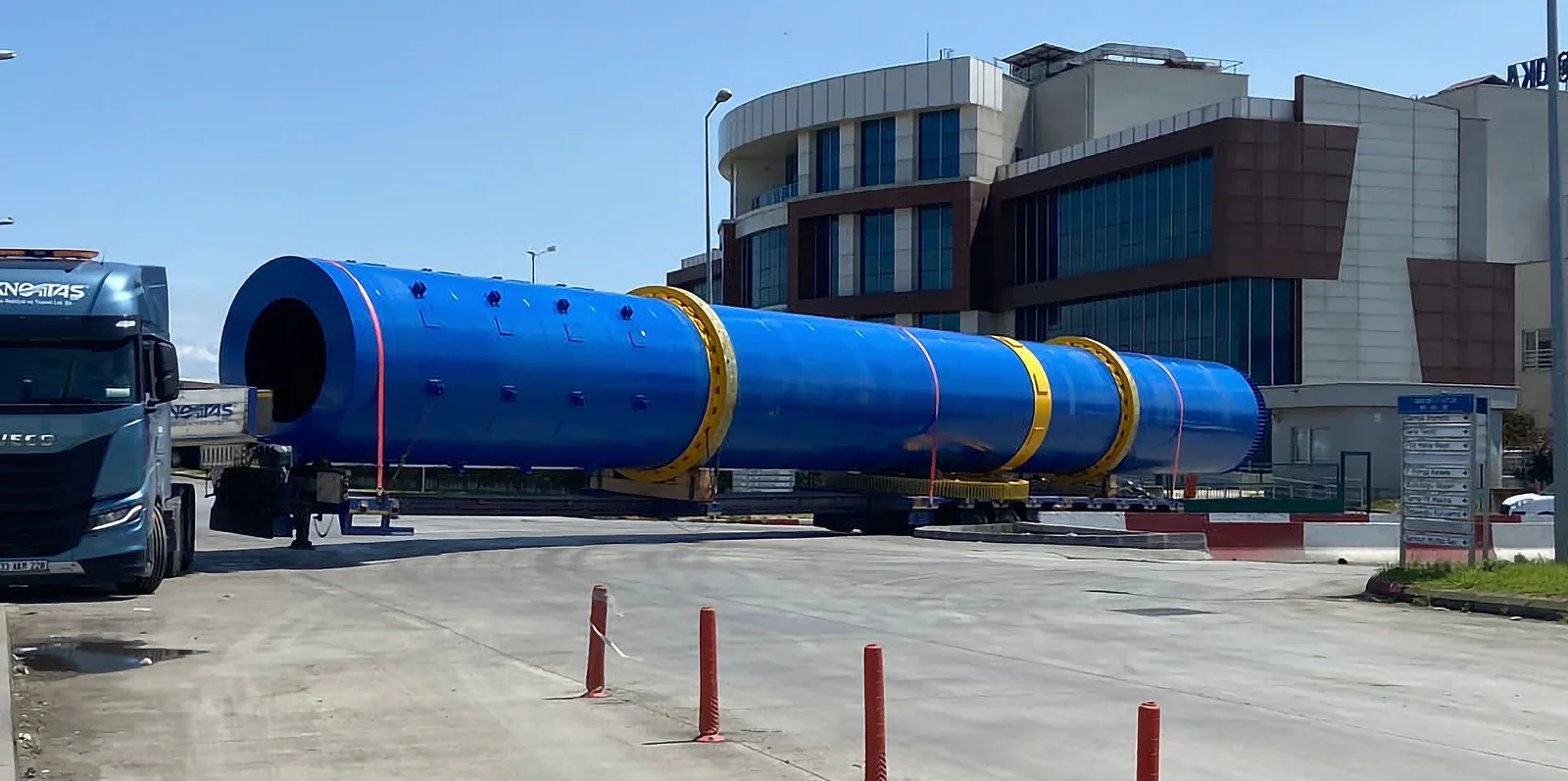
A rotary dryer is a long, slightly inclined, rotating drum that dries bulk solids by continuously lifting and showering the material through a stream of hot gas.
The operating principle of a rotary dryer depends on not just “heat”—but by contact area + residence time + controlled airflow.
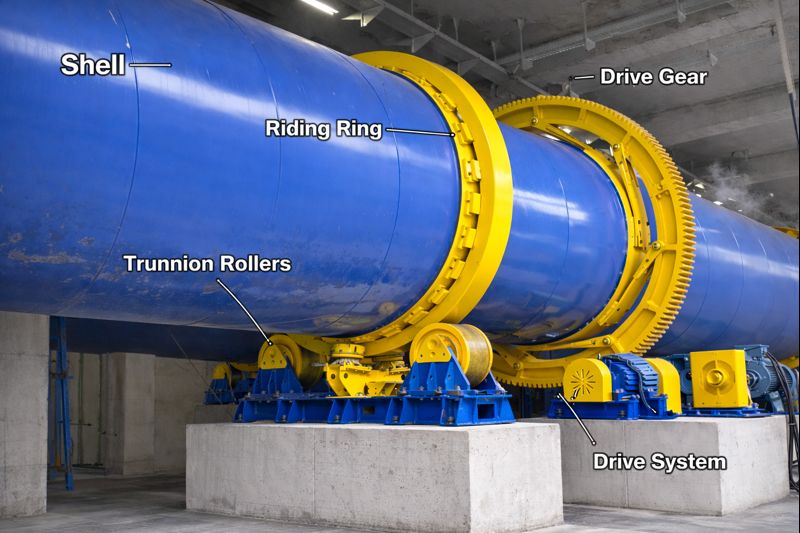
A typical rotary dryer system is consisted of;
- Shell (drum cylinder) – carbon steel / stainless / high-alloy depending on corrosion + temperature; may be insulated
- Flights (lifters) – create the falling “curtain” that maximizes air-to-material contact (this is the #1 driver of drying rate)
- Riding rings / tires – carry drum load and transfer it to the support rollers.
- Trunnion wheels (support rollers) – the cradle the tires roll on; precision alignment controls wear and smooth rotation.
- Thrust rollers – prevent axial “drift/walking” of the drum along its slope.
- Drive assembly – motor + reducer + coupling driving pinion + girth (ring) gear; guards + automatic gear lube are standard on heavy duty units.
Step-by-step: what actually happens inside the dryer drum;
Step 1 — Spiral flights move material away from the inlet fast
Near the inlet, you commonly use spiral flights to push material away from the load point. This prevents spillage and avoids a big dead zone at the inlet.
Step 2 — Lifting flights create a “curtain” of falling solids
As the drum rotates, lifting flights scoop material and drop it through the hot gas stream. This creates a shower/curtain, maximizing heat and mass transfer area.
That repeated showering is why rotary dryers work well at high throughput.
Step 3 — Moisture is removed through convection + evaporation
Most industrial rotary dryers are direct-fired (hot gas contacts product). The gas transfers heat to particle surfaces; moisture evaporates; vapor is carried away by the exhaust gas.
Even a small % change is a big water load at hundreds of tons/hour. That’s why airflow and gas temperature matter so much.

Kaan
Kaan Ceylan is a seasoned Machine Designer and Development Manager specializing in heavy-duty process systems for the fertilizer production industry. He serves at Ceylan Machine & Process (Ceylan Machinery) in Mersin, Turkey, which is known for engineering granulation technology and process equipment.